E-commerce Payment Fraud Prevention Guide 2026
- E-Commerce payment fraud prevention: The 2026 Guide for Online Businesses in Spain
- What exactly is a secure online purchase and why is it vital today?
- Operational impact of secure online purchasing on conversion and profitability
- Architecture and technical operation of a secure online purchase
- Regulatory compliance and security: PCI-DSS and data protection
- Use cases: secure online purchasing according to your business model
- Comparison: direct acquiring vs. intermediation models
- Conclusion: payment security as a competitive advantage
- Sources and reference regulations
E-Commerce payment fraud prevention: The 2026 Guide for Online Businesses in Spain
Payment fraud and cart abandonment are the two most critical losses for any digital business. You either lose money through chargebacks, or you lose sales due to payment gateways with excessive friction.
In this guide, you will learn exactly what happens in the milliseconds a transaction lasts and how to structure a secure online purchase that eliminates fraud without destroying your conversion rate, supported by the European regulatory framework and direct acquiring technology.
What exactly is a secure online purchase and why is it vital today?
The technical definition of transactional security
At an infrastructure level, a secure online purchase is the encrypted exchange of financial credentials between a merchant, an acquirer, card schemes, and the issuing bank. This process requires the tokenization of primary account number (PAN) and identity validation using protocols such as 3-D Secure. The technical objective is to guarantee the integrity of the data package and authenticate the user without compromising transaction latency.
If the chain fails, the risk falls on the weakest link: statistically, the merchant.
Reference data: According to Juniper Research (Global Merchant Fraud Prevention Market 2024-2029), e-commerce fraud reached 44.3 billion dollars in 2024 and is projected to exceed 107 billion in 2029. The hidden cost is not just direct fraud: according to industry data, false declines cost merchants several times more than actual fraud.
Real impact on merchant treasury
A poorly configured payment system penalizes your cash flow on three fronts:
- Chargeback costs: Direct penalties from your acquiring bank for fraudulent transactions.
- False positives: Legitimate transactions denied by poorly calibrated risk engines. These are invisible in reports but devastating for conversion.
- Retention costs (Rolling Reserve): Money held by processors that classify your operation as a high-risk business, freezing working capital.
Optimizing secure online purchases means reducing false rejections by 15-20% and bringing the chargeback rate below 1%. This translates directly into margin for your bottom line.
European regulation as a framework for action
From the position of a regulated Payment Institution, secure online purchasing is structured around the PSD2 Directive and its requirement for Strong Customer Authentication (SCA). The key is not to apply it always, but to know when to request legitimate exemptions to eliminate friction without compromising security.
Regulatory note: PSD2 entered into force across the European Union in 2019, and its technical SCA regulation became mandatory as of January 2021. Regulated payment entities like PayOk are supervised by the Bank of Spain and are required to comply with these standards in every transaction processed.
Critical elements of a secure transaction
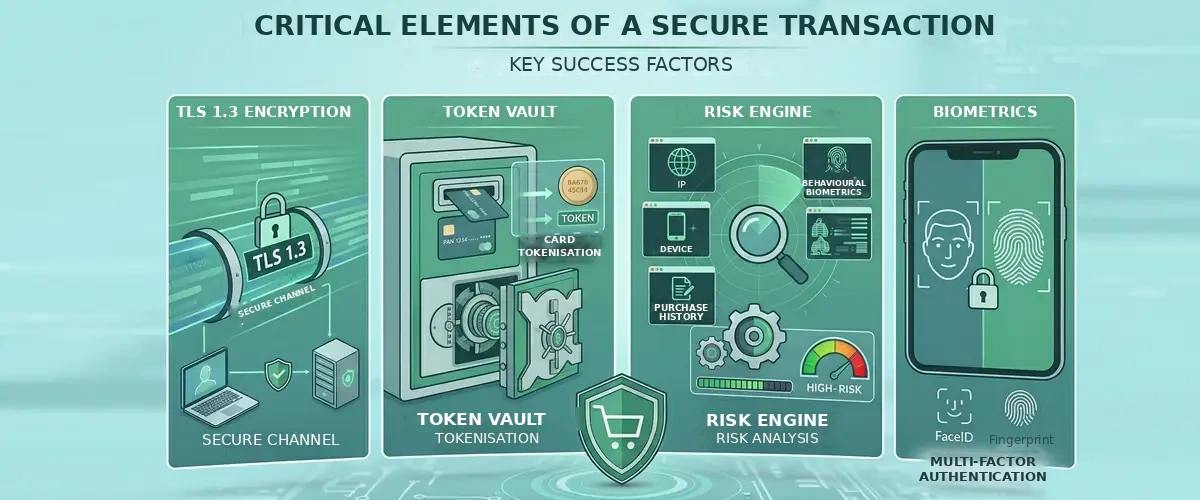
To guarantee transactional success, these four technological pillars intervene:
- TLS 1.3 Encryption: Encrypted communication channel between the customer's browser and the acquirer's server.
- Token Vault: Card numbers (PAN) are replaced by irreversible alphanumeric tokens before any storage.
- Real-Time Risk Engine: Algorithms that evaluate IP, device, purchase history, and behavioral biometrics in milliseconds.
- Biometric Authentication: Delegation of the second authentication factor (FaceID, fingerprint) through the issuing bank's app.
Operational impact of secure online purchasing on conversion and profitability
The dilemma: Friction vs. Authorization
Adding layers of security without criteria destroys conversion. If you force a customer to look for their coordinates card for a €15 purchase, they will abandon the cart before completing the payment.
Technical optimization consists of implementing the Frictionless Flow of the 3DS2 protocol: the merchant and the acquirer send more than 100 contextual data points to the issuing bank (IP, typing speed, screen resolution, device history). If the issuer trusts this information, they approve the operation silently. This is secure online purchasing at its best: maximum security with minimum friction.
The impact on sales of a poor checkout is quantifiable. Consider an e-commerce with €100,000 in monthly turnover:
| Scenario | Payment abandonment | Lost revenue |
|---|---|---|
| Unoptimized gateway | 30% | €30,000/month |
| Gateway with SCA exemptions (TRA) | 10% | €10,000/month |
| Recoverable difference | — | €20,000/month |
Note: The percentages in the example are illustrative. Real rates vary by sector, average ticket, and gateway configuration. Industry benchmarks place checkout abandonment between 17% and 35% according to Baymard Institute (2024).
That is €240,000 annually recoverable just by optimizing the gateway. The ROI of a good payment integration is, in most cases, the highest of any technical business optimization.

SCA exemption management: how to reduce friction within regulations
The PSD2 allows certain transactions to be exempt from double authentication. The most relevant exemptions are:
- Low Value Exemption: Purchases under €30, provided that 5 consecutive operations or a cumulative €100 are not exceeded.
- Transaction Risk Analysis (TRA): If the processor maintains fraud rates below EBA thresholds, they can exempt purchases up to €500.
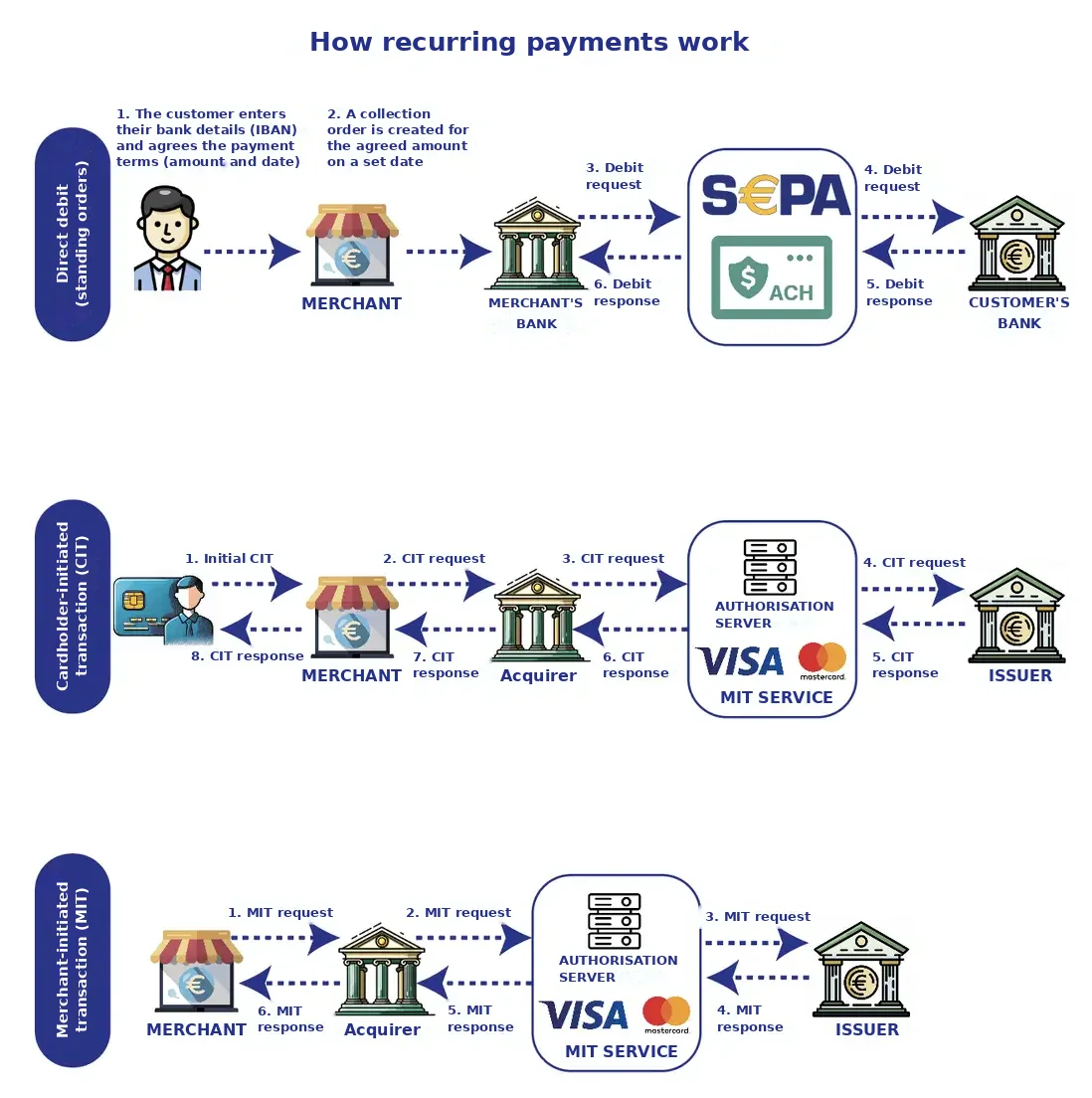
- Subscriptions and recurring payments (MIT): Merchant Initiated Transactions where the customer is not present, referenced to the initial collection with SCA.
False positives: the silent fraud that no one measures
A false positive occurs when the gateway rejects a completely legitimate customer because the risk engine erroneously identifies them as suspicious. It is the most silent damage to the system.
Most frequent causes:
- Static and outdated fraud rules (for example: "block all foreign IPs" in stores selling throughout Europe).
- Mismatches in AVS (Address Verification System) validation when the billing address does not exactly match the one registered at the bank.
- Lack of data shared with the issuing bank, preventing it from approving in silent mode.
Direct consequences for the business:
- Immediate loss of sale: The customer goes to the competition in seconds.
- Reputational damage: An unfairly rejected customer rarely returns and often leaves negative reviews.
- Wasted CAC: You have paid to attract a customer that your own gateway has expelled.
Architecture and technical operation of a secure online purchase
The payment lifecycle: what happens in every millisecond
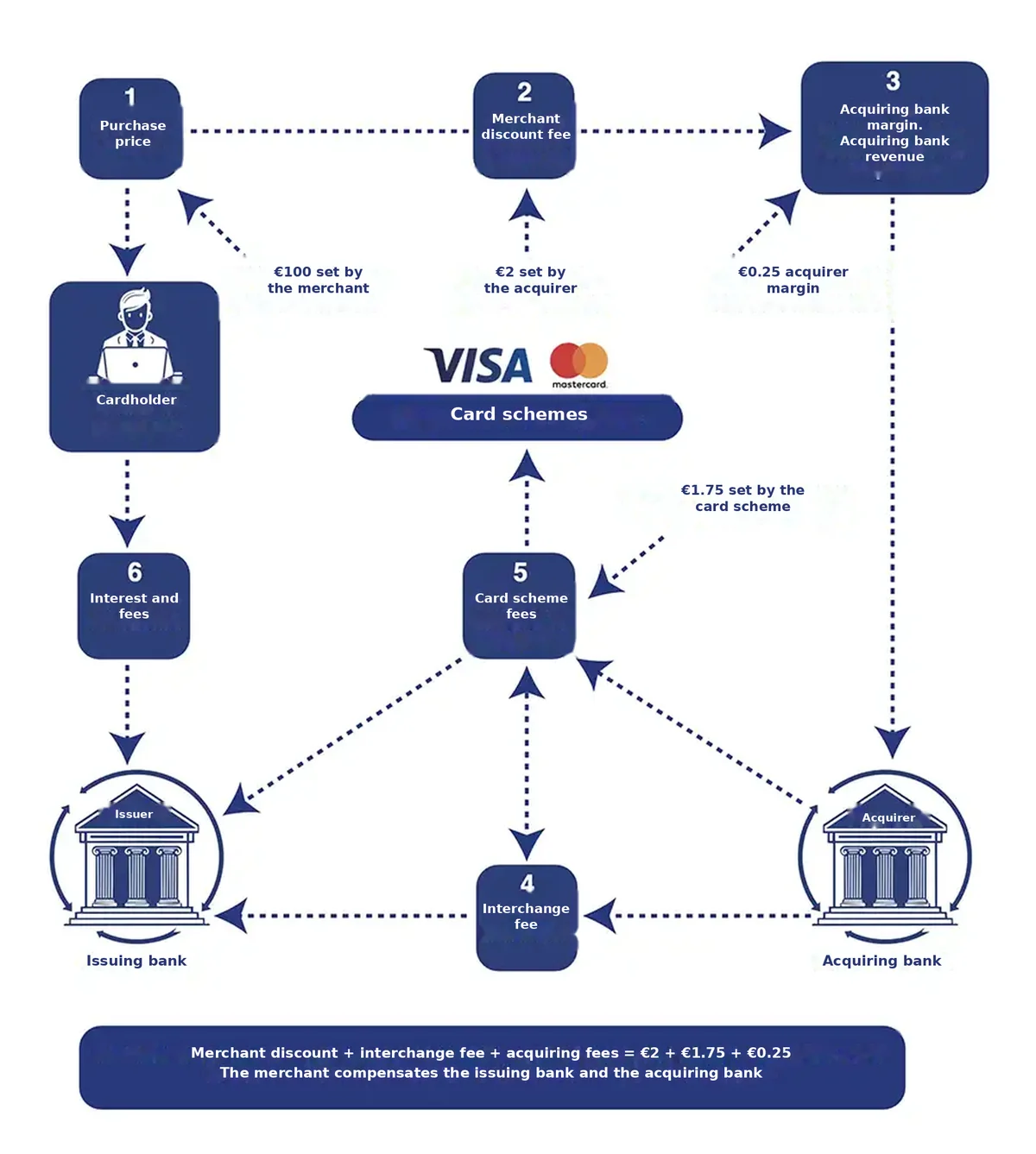
A secure online purchase is not a single click: it is a sequence of API calls between multiple institutional actors. When the user clicks "Pay", the gateway packages the encrypted data and sends it to the acquirer, who routes it to the card brand, which in turn sends it to the issuing bank to verify funds and evaluate risk.
This entire process must be executed in less than 2 seconds. Latency here is not a technical problem; it is a sales problem.
The impact of Uptime on billing
An availability of 99.0% implies more than 3 days of downtime per year. During a Black Friday campaign, that can mean thousands of euros lost in hours. A bank-grade architecture must guarantee 99.99% Uptime, supported by load balancers and redundant servers in multiple geographic zones.
Payment aggregators act as intermediaries: if they go down, you don't get paid. A regulated Payment Entity that works directly with top-tier acquiring banks eliminates this point of failure.
Technical note: The difference between 99.0% and 99.99% availability is not marginal: it is 3 days and 15 hours of inactivity versus less than 53 minutes per year. In a Black Friday where several thousand transactions per hour can be processed, every minute of downtime has a direct cost in uncollected revenue.
Critical steps of technical integration
To process payments professionally and securely, the integration must include:
- Server-to-Server (S2S) / API REST Integration: Total control of the data flow in the checkout, without depending on external redirects that increase abandonment.
- Webhook Management: Asynchronous notifications to update order status in your ERP instantly, avoiding orders in a limbo state.
- Card Tokenization: Storing the acquirer's token to enable one-click purchases (One-Click Checkout) on future visits, increasing the conversion of recurring customers.
- Sandbox Environment: Exhaustive stress tests simulating fraud, insufficient funds, and timeouts before going live.
Regulatory compliance and security: PCI-DSS and data protection
The PCI-DSS standard and tokenization
PCI-DSS is not optional. It is the global framework that dictates how card data should be handled. Any merchant that processes, stores, or transmits card data must comply with it, regardless of their size.
Capturing card data on your own servers without Level 1 certification is negligence with direct consequences. The solution is tokenization with iFrame fields: sensitive data travels directly from the customer's browser to the encrypted servers of the certified acquirer, without touching the merchant's database at any time. Your servers only receive an alphanumeric token with no value outside that system.
Sanctions and loss of license: the real consequences of non-compliance
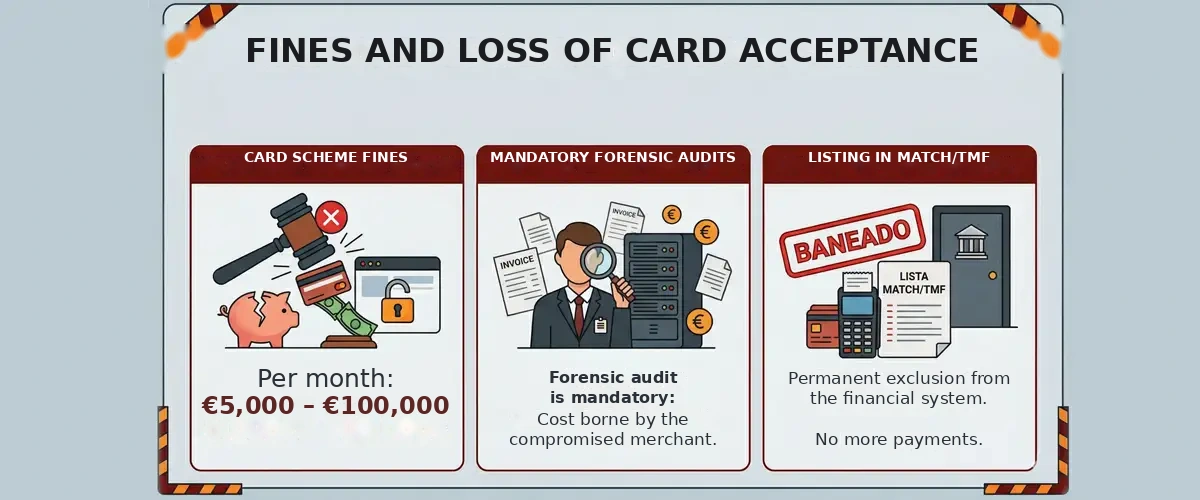
Non-compliance with PCI-DSS is not an abstract risk. The concrete consequences are:
- Visa and Mastercard fines: Between €5,000 and €100,000 per month of documented infringement.
- Mandatory forensic audits: In case of a breach, the full cost is assumed by the compromised merchant (can exceed €50,000).
- Inclusion in MATCH/TMF lists: The definitive blacklist of the payment industry. Once included, no acquirer will process your transactions again. In practice, it means the closure of the digital business.
Ensuring a secure online purchase is, above all, a legal and operational risk mitigation strategy.
The anti-fraud shield: key tools for secure online purchasing
These are the technologies that form the invisible protection layer for the end user:
- Velocity Checks: Automatic blocking of multiple failed payment attempts from the same IP in short time windows. Essential to stop carding attacks (mass testing of stolen cards).
- Device Fingerprinting: Identification of compromised devices, browser emulators, or connections through Tor networks and anonymous proxies associated with fraudulent activity.
- Inconsistent Geolocation: Detection of discrepancies between the connection IP, the card's issuing country, and the declared shipping address.
- Dynamic Blacklists: Real-time updating of BINs (Bank Identification Numbers) with historically high fraud rates.
- Behavioral Biometrics: Analysis of typing patterns, cursor movement, and behavior within the form. Detects bots and scripts without adding visible friction to the legitimate user.
Use cases: secure online purchasing according to your business model
Retail E-commerce: high volume, low ticket
In fashion, consumer electronics, or online food, transaction volume is massive and margins are tight. The enemy is cart abandonment due to friction at checkout.
Recommended strategy: Implement one-click payments through card tokenization and systematically request low-value exemptions for tickets under €30. The objective is to maximize the percentage of transactions that pass without friction.
Acquiring approach: Optimize routing to maximize frictionless transactions and ensure infrastructure that supports extreme traffic peaks during campaigns like Black Friday.
B2B Services and SaaS: high ticket, low volume
Sales of business software or B2B services involve high average tickets (€500 - €5,000). The problem is not the volume, but the guarantee of collection and the limits of corporate cards.
A rejection on a €3,000 ticket has a disproportionate impact on the weekly revenue forecast.
Recommended strategy: Offer the payment option via Payment Link so that the customer's finance department can complete the transaction in an environment authenticated with correctly applied SCA. This reduces commercial chargebacks practically to zero.
Subscription Models: recurring transactions (MIT)
Monthly billing for gyms, streaming platforms, or SaaS depends on Merchant Initiated Transactions (MIT). If the gateway does not mark them correctly, the issuing bank will demand customer authentication for every monthly charge, generating failed payments and involuntary customer churn.
Correct implementation: The initial charge is marked as CIT with full SCA, generating a network identifier. All subsequent charges are sent as referenced MITs, ensuring silent and continuous authorization.
Note for SaaS and subscriptions: A frequent error is not saving the network identifier generated in the initial charge. Without this data, each recurring charge reaches the issuing bank without context and may be treated as a new transaction, forcing the customer to authenticate or causing a silent rejection. The result of customer loss never appears in cancellation reports.
Comparison: direct acquiring vs. intermediation models
The problem of opaque intermediaries
The payment market is full of technology resellers: companies that offer an attractive commercial interface but behind the scenes send operations to a processor, which sends them to an acquirer, for example, Visa. Each link adds latency, opacity in reconciliation, and a margin that you pay.
This Blended Pricing model is structurally opaque: you never know what real commission you are paying for each type of card.
Impact on settlement times and cash flow
Traditional aggregators take between 3 and 7 days to settle funds. Additionally, they withhold percentages of billing as a guarantee. Without access to gross clearing reports, reconciling accounting becomes a multi-hour task at every month-end closure.
You cannot have a secure online purchase if your own money is not available and controlled.
Advantages of the Payment Facilitator (PayFac) model
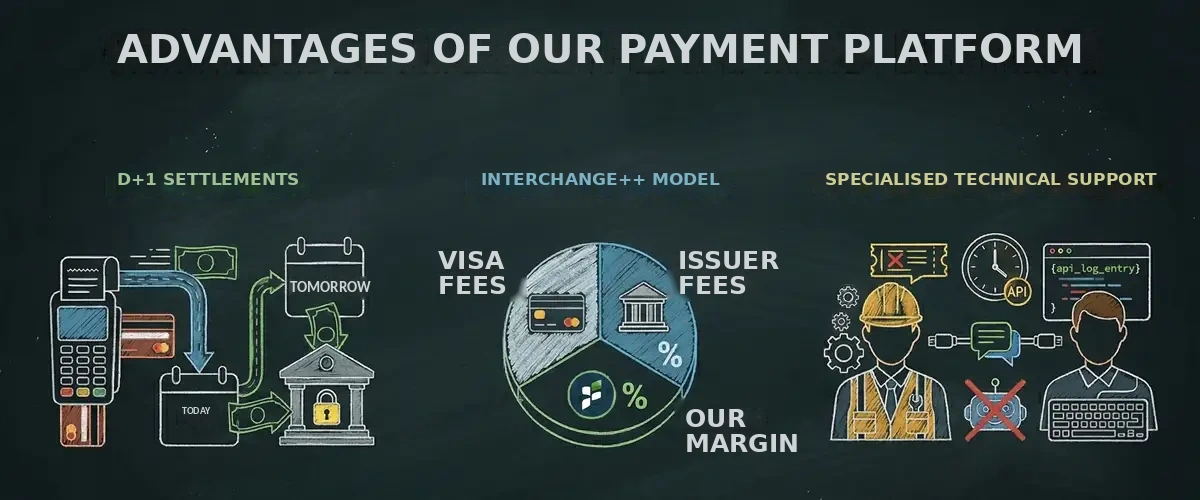
The payment facilitator model with direct acquiring changes the rules of the game:
- D+1 Settlements: Money processed today is in your account tomorrow (for low-risk merchants).
- Interchange++ Model: Absolute transparency. You see exactly what card schemes charge, what the issuing bank charges, and what the acquirer's margin is. No hidden costs.
- Specialized Technical Support: When a transaction fails in production, engineers with access to API logs analyze the problem in real-time, rather than an automated ticket system.
Operational advantages of direct acquiring
- Accelerated Digital Onboarding: Agile internal risk assessment, processing applications in days instead of months.
- Control of B2B and B2C Flows: Optimized processing for both consumer debit cards and high-limit corporate cards.
- Centralized Dispute Management: Unified dashboard to respond to chargebacks by attaching evidence (shipping receipts, IP logs) in a single flow.
Conclusion: payment security as a competitive advantage
Secure online purchasing is not an infrastructure expense. It is a measurable growth lever. Every percentage point of cart abandonment you eliminate, every false positive you avoid, and every chargeback you don't have to manage translates directly into margin.
If your current payment gateway is slowing down your growth, if you suffer from abandonment rates higher than 20% at checkout, or if your fund settlements take more than 48 hours (provided merchant risk allows), you have an infrastructure problem, not a product problem.
At PayOk Financial Services, S.L., as a payment facilitator, we eliminate unnecessary intermediaries so that every secure online purchase on your platform is a lever for growth, not a bottleneck.
Are you ready to professionalize your payment architecture?
Sources and reference regulations
- PSD2 Regulation:Directive (EU) 2015/2366 - European Parliament
- EBA SCA Guide:RTS on Strong Customer Authentication - European Banking Authority
- PCI-DSS v4.0:PCI Security Standards Council
- Fraud Statistics: Juniper Research, Global Merchant Fraud Prevention Market 2024-2029 (octubre 2024)
- Abandonment Benchmarks:Baymard Institute, E-Commerce Checkout Usability 2024
Check that the URL starts with HTTPS and that the browser shows the padlock icon. Then look for a privacy policy, a legal notice, real contact details and recognisable payment methods (Visa, Mastercard, Bizum). Be wary of abnormally low prices, domains with small spelling changes and shops with no verifiable reviews on Google.
SCA is a requirement of the European PSD2 regulation. It requires the buyer's identity to be verified with two independent factors, chosen from something you know, something you have and something you are, so that the person paying is the actual cardholder and not a third party using stolen data.
Yes, provided the store uses certified tokenisation. Your real card number is never stored on the merchant's servers: it is replaced by an alphanumeric token that has no value outside that system. If the merchant's database is breached, the attacker gets useless tokens rather than real card data.
Contact your bank straight away to start a chargeback. You have the right to dispute unauthorised transactions. Change your password for that store as well and, if the card number has been compromised, ask your bank to issue a new card.
The decline may come from your bank (security limits, geolocation, unusual spending patterns) or from the shop's anti-fraud engine as a false positive. Try another payment method or call your bank to check that no restrictions are active. It can also happen when the billing address does not match exactly the one registered with your bank.
Yes. Any merchant that processes payment card data must comply with PCI-DSS. The most efficient route is tokenisation with iFrame fields: the data goes straight to the certified processor without passing through your servers, which sharply reduces both your liability and the scope of any audit.
Was this post useful?

Leave a Comment
Ready to get started?
Create your PayOk account in minutes. No maintenance fees, pay per transaction.