
How to submit a complaint to the Bank of Spain
- Complaint to the Bank of Spain: the definitive guide to defending your rights as a financial consumer
- The real impact of a complaint to the Bank of Spain on your finances
- Process architecture: how a complaint to the Bank of Spain works step by step
- Regulatory compliance: PSD2, consumer protection, and applicable legal framework
- Bank of Spain complaint in action: real reasons to file a claim
- Errors that invalidate your complaint: reasons for inadmissibility
- Conclusions
Complaint to the Bank of Spain: the definitive guide to defending your rights as a financial consumer
Your bank charges you a fee that does not appear in the contract. You call, you file a complaint at the branch, and the response is silence that lasts for weeks. Every day without a solution is another day your money stays where it shouldn’t.
A complaint to the Bank of Spain is the regulatory tool that forces your financial institution to take a position before the supervisor. And in this guide, you will learn exactly how to activate it.

By the time you finish reading, you will master three concrete things:
- The mandatory preliminary protocol without which the Bank of Spain automatically rejects your case.
- The exact deadlines set by law, which differ depending on whether you are a consumer, a business, or whether your issue involves payment services.
- The precise documentation you need so your complaint doesn’t end up forgotten in a drawer.
What a complaint to the Bank of Spain is and why it truly protects your money
A complaint to the Bank of Spain is not an informal grievance. It is a formal administrative procedure before the Department of Market Conduct and Claims, the body that oversees whether a financial institution has breached transparency rules and customer‑protection regulations.
The supervisor analyzes whether the bank, payment institution, or electronic‑money institution has violated good financial practices. After the investigation, it issues a reasoned report which, although not legally binding like a court ruling, creates real regulatory pressure. Institutions that receive unfavorable opinions often rectify to avoid the case escalating into sanctions.
The PSD2 Directive and its Spanish transposition through Royal Decree‑Law 19/2018 strengthened the rights of payment‑service users with strict response deadlines and transparency obligations. If your institution fails to comply, the Bank of Spain acts as an arbitrator.
The Bank of Spain only intervenes in matters of transparency and good banking practices. It has no authority over abusive clauses (floor clauses, mortgage expenses), which fall under the courts. It also does not intervene in investments (CNMV), insurance (Directorate‑General for Insurance), or data protection (AEPD).
The real impact of a complaint to the Bank of Spain on your finances
When a financial institution charges improper fees or withholds funds without justification, the damage is not only economic. It affects your financial planning and, if you are self‑employed or a microbusiness, your operational cash flow.
Doing nothing has direct consequences. You may lose your right to claim due to expiration (deadlines are strict), and the institution interprets your silence as acceptance. You also give up a supervisor’s opinion that could serve as expert evidence in a future lawsuit.
A well‑documented case produces tangible results. According to the Bank of Spain’s Claims Report, a significant percentage of institutions rectify when the opinion issued is unfavorable to them.
For microbusinesses (fewer than 10 employees and turnover under 2 million euros), RDL 19/2018 extends the same protections granted to individual consumers. Your institution must provide the same transparency and rights as it would to any natural person.
Process architecture: how a complaint to the Bank of Spain works step by step
The flow is sequential and mandatory. Skipping any step invalidates the process, and this structure forces institutions to use their own resolution systems before the regulator intervenes.
Step 1: prior complaint to the Customer Service Department (mandatory)
You cannot go directly to the Bank of Spain. The law requires you to first file a formal complaint with your institution’s Customer Service Department (SAC) or Customer Ombudsman.
Submit a formal written complaint through any of these channels: stamped at the branch, certified mail, burofax, or a traceable online form. Always keep proof of submission.
Response deadlines for the institution (Article 69 of RDL 19/2018):
- 15 business days for payment services (cards, transfers, Virtual POS, direct debits).
- 1 month for consumers in other banking matters.
- 2 months if you are claiming as a business or non‑consumer professional.

Going directly to the Bank of Spain without first complaining to your institution is an automatic cause for inadmissibility. It is the most common—and most time‑consuming—mistake.
Step 2: escalation to the Bank of Spain
Once the preliminary stage is exhausted, submit your complaint to the Department of Market Conduct and Claims through one of the following channels:
- Bank of Spain electronic office (https://sedeelectronica.bde.es/sede/en), using a digital certificate or Cl@ve.
- Postal mail to Calle Alcalá 48, 28014 Madrid.
- In person at Bank of Spain branches, by appointment.
Documentation you must provide:
- ID (DNI) or tax ID (CIF), full name, and address for notifications.
- Identification of the institution and the branch involved.
- Copy of the complaint submitted to the SAC and the response received (or proof that the deadline has expired).
- Contracts, bank statements, communications, and evidence supporting your case.
- Original handwritten signature or valid electronic signature.
Always submit photocopies, never originals. If you are claiming against multiple institutions, file one form for each of them.
Regulatory compliance: PSD2, consumer protection, and applicable legal framework
The PSD2 Directive and RDL 19/2018 establish that every payment‑service provider must have a SAC that resolves complaints within a maximum of 15 business days. Users have 13 months to dispute an unauthorized or incorrectly executed transaction. If the institution failed to apply strong customer authentication (SCA), liability for fraud falls on the institution.
Order ECO/734/2004 requires institutions to maintain an accessible and free complaint procedure. Regulations demand transparency in framework contracts, including execution deadlines and itemized fees. If your institution fails to comply, you already have an additional reason to file a complaint.
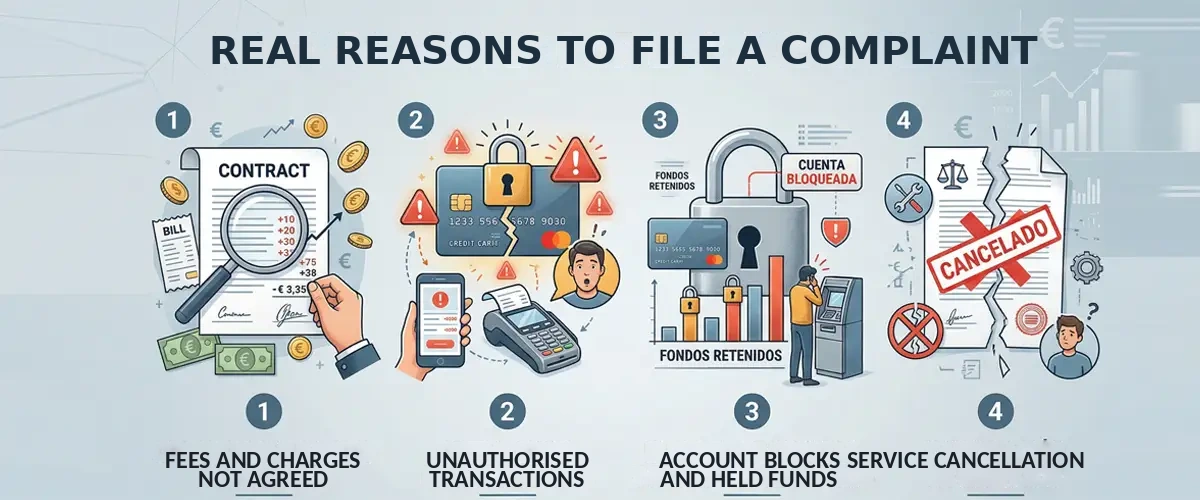
Bank of Spain complaint in action: real reasons to file a claim
Unagreed fees and charges
This is the most common reason. It includes non‑contractual maintenance fees, charges for services you never requested, and unilateral changes to pricing without the two‑month notice required by law. Provide the original contract and the statement showing the improper charge: the difference between the two is your proof.
Unauthorized transactions
Duplicate charges, incorrect transfers, or payments from unknown merchants. PSD2 establishes that the burden of proof lies with the institution: it is the bank that must demonstrate the transaction was properly authenticated.
Account blocking and fund withholding
Institutions may block funds for regulatory‑compliance reasons, but they must do so in a justified and proportionate manner. A generic block without explanation may constitute a bad banking practice that can be challenged.
Service cancellation
The user may terminate the framework contract at any time. If the contract is older than 6 months, cancellation must be free of charge. Abusive closure fees are a legitimate reason to file a complaint.
Describe the facts with dates, amounts, and specific references. A statement such as “I was charged €35 on March 15 without contractual basis on account ESXX‑XXXX” has a much higher chance of success than a generic complaint about “abusive fees”.
Errors that invalidate your complaint: reasons for inadmissibility
The Bank of Spain rejects a significant percentage of complaints due to formal defects. The five main reasons:
- No prior complaint to the institution. Automatic cause for inadmissibility.
- Expiration. More than 1 year since the SAC complaint without escalating to the Bank of Spain (consumers).
- General statute of limitations. More than 5 years since the events with no complaint filed.
- Open judicial proceedings. If a judge is reviewing the same case, the supervisor withdraws.
- Matters outside its jurisdiction. Abusive clauses, investments, insurance, or data protection.
Conclusions
The Bank of Spain’s complaint system works, but only if you activate it correctly. The difference between a successful case and a rejected one usually lies in the documentation and compliance with the protocol.
Working with regulated payment institutions that prioritize fast incident resolution reduces the need to escalate to the supervisor. PayOk Financial Services, S.L., a licensed payment institution (BE 6928) supervised by the Bank of Spain, structures its operations to resolve conflicts before they escalate.
For payment services, 15 business days (Article 69, Royal Decree-Law 19/2018). In exceptional cases it can extend this to one month, but it must tell you why. For other banking products, the general deadline is now one month.
No. Your complaint will be rejected. You must show that you first complained to your bank's Customer Service Department or Customer Ombudsman, and that they rejected your claim, fully or partly, or did not answer in time.
Not directly. The Bank of Spain's report is not binding, but it puts real pressure on the bank and works as strong expert evidence if you decide to go to court.
As a consumer, you have one year from the date you filed your complaint with the bank to take it to the Bank of Spain. After that, your complaint will not be accepted, although you can still go to court.
Your ID (DNI, NIE or passport) or your company tax ID (CIF), the contract for the product, bank statements showing the disputed transactions, and your complaint to the bank with its reply. Add emails or screenshots as supporting evidence.
Was this post useful?
1 of 1 I found it useful

Leave a Comment
Ready to get started?
Create your PayOk account in minutes. No maintenance fees, pay per transaction.