Payment facilitator: How a PayFac simplifies your payments
- Payment facilitator: a technical and operational guide to scaling your collections in 2026
- What is a payment facilitator and why does it define your business profitability today?
- The real impact of a payment facilitator on conversion, treasury, and margin
- Technical architecture: how a payment facilitator works behind the scenes
- Regulatory compliance: PSD2, PCI-DSS, 3DS and fraud prevention
- Payment facilitator in action: sector-specific use cases
- PayFac vs. traditional models: why sub-acquiring wins
- Real cost comparison
- Advantages of a payment facilitator over a traditional bank
- Disadvantages of payment facilitators you should know
- Advantages of traditional banks over payment facilitators
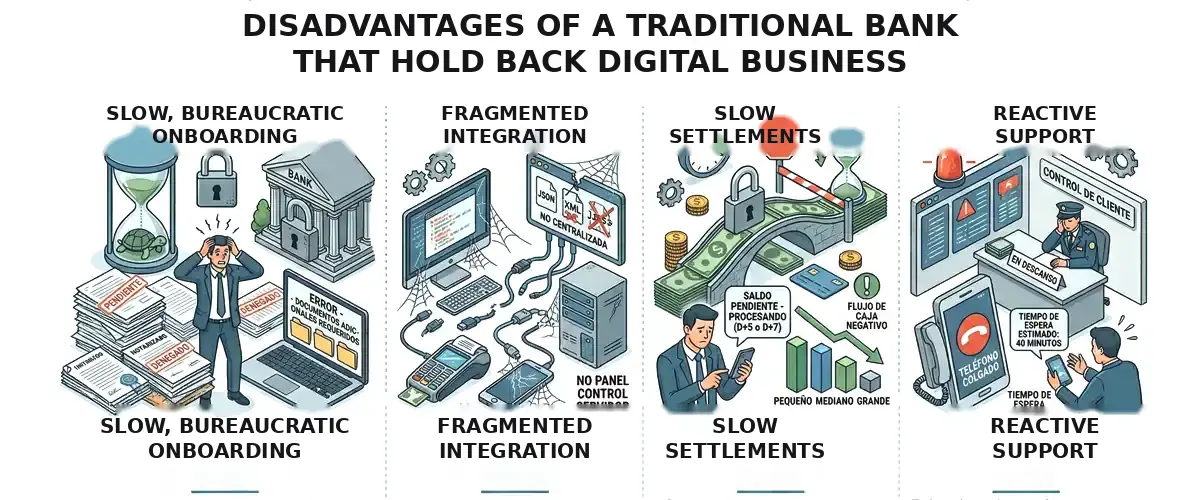
- Disadvantages of traditional banks that hinder digital commerce
- Settlement speed and cash‑flow control
- Advantages of the Payment Institution model over a payment aggregator
- Payment infrastructure as a competitive advantage
Payment facilitator: a technical and operational guide to scaling your collections in 2026
Your business has been waiting three weeks for the bank to activate a Virtual POS. The sales team has customers ready to pay, but the bureaucracy of the traditional acquirer has frozen your invoicing. Every day without collecting is money evaporating and a competitor gaining ground.
This guide exists to eliminate that bottleneck. You won't find academic theory or definitions copied from Wikipedia. Here, I will break down the real architecture of a payment facilitator, its measurable impact on treasury and conversion, and the European regulatory framework that sustains it.
By the time you finish reading this guide, you will learn the following:
- What a payment facilitator is at a technical level and why it accelerates your time-to-revenue.
- How sub-acquisition works behind the scenes, including the full API flow.
- Regulatory obligations (PSD2, PCI-DSS, AML/CFT) and how a payfac manages them.
- Real use cases by sector and an honest comparison against the classic banking model.
 What is a payment facilitator and why does it define your business profitability today?
Technical definition: what a payment architect understands
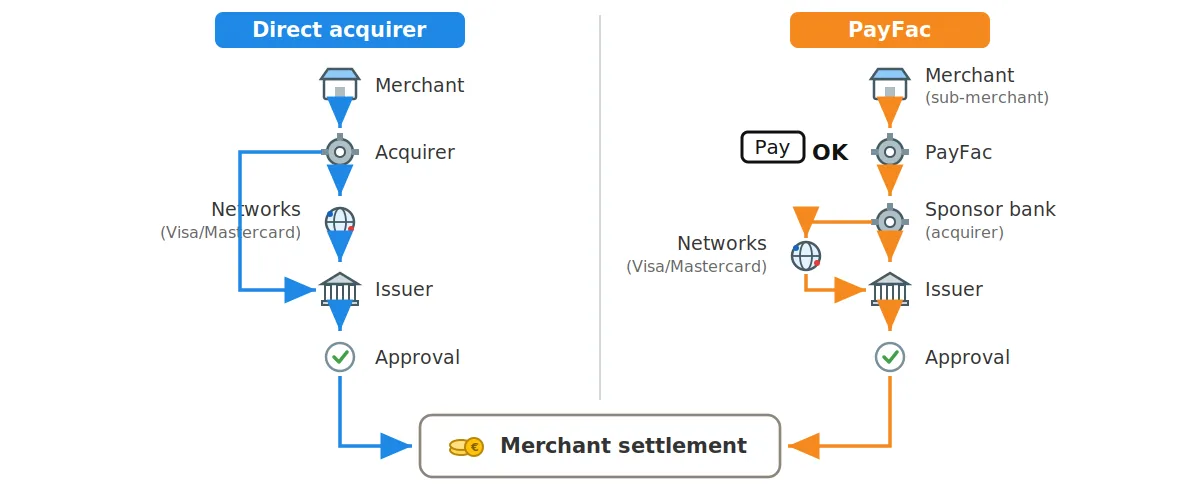
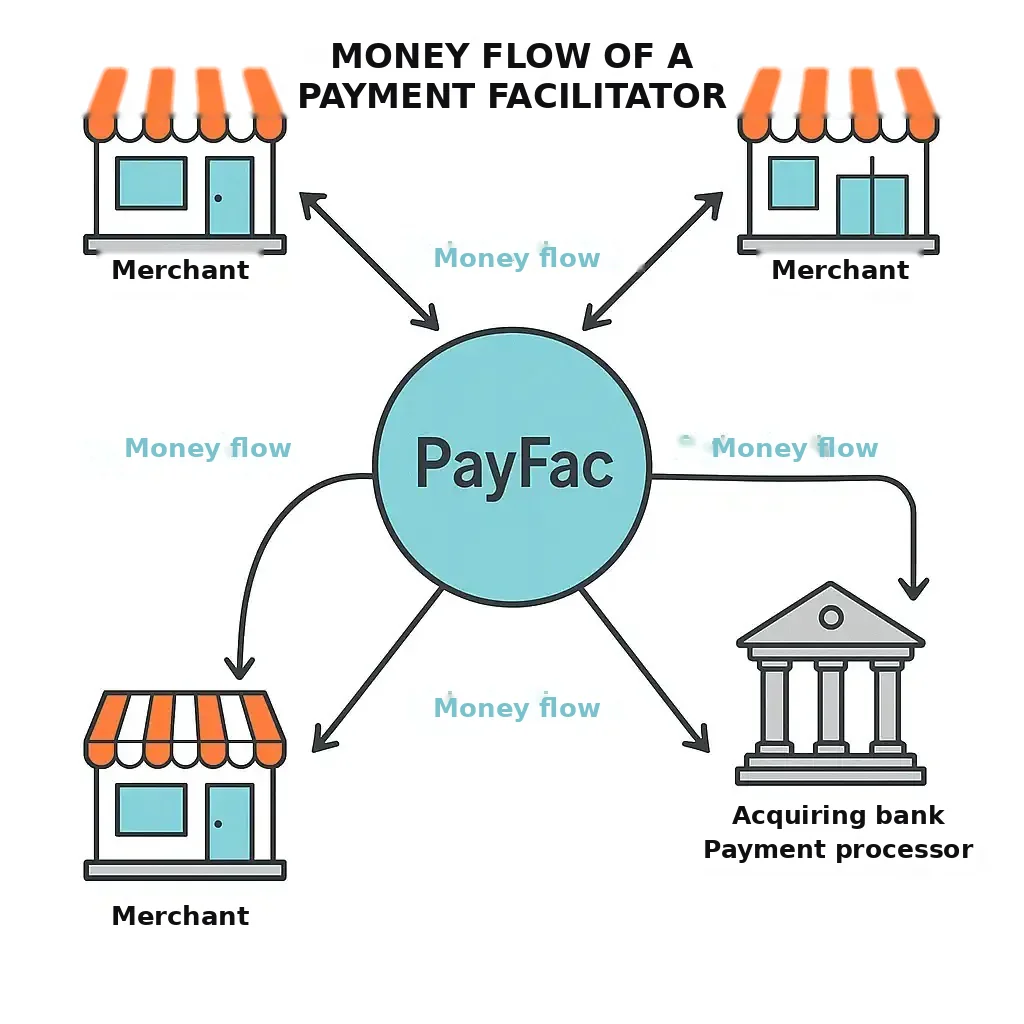
A payment facilitator (also known as a PayFac) is a regulated entity that operates under contract with a premium acquirer that maintains a direct connection with card schemes (Visa, Mastercard, JCB, UnionPay). The sponsoring acquirer provides access to the settlement rails, while the facilitator provides the technological layer, risk management, and sub-merchant onboarding.
Technically, the facilitator establishes a Master Merchant Account through the sponsoring acquirer. From there, it gains the authority to sub-aggregate merchant accounts under its own master merchant identifier (Master MID). This means that hundreds or thousands of sub-merchants can process payments without each needing to obtain their own independent bank contract.
The payment facilitator assumes responsibility for financial risk (underwriting), executes the KYC/KYB for each sub-merchant, and manages reconciliation, refunds, and disputes centrally.
What really matters to the CFO and the business owner
For the financial manager, a payment aggregator solves a critical operational problem: time. In a classic banking model, registering a new merchant requires submitting notary deeds, enduring weeks of review, and negotiating conditions case by case. This process destroys the cash flow of any platform that needs to onboard sellers at scale.
With a sub-acquisition model, the merchant signs a digital contract, completes identity verification in minutes, and starts collecting the same day. The impact on the Time-to-Revenue metric is massive: from 20–30 days to less than 24 hours. Platforms like Shopify or Mindbody have built their growth on this premise.
The real impact of a payment facilitator on conversion, treasury, and margin
Industry data and proprietary operational references
According to data from the European Central Bank, card payment processing in the Eurozone exceeded 58 billion annual transactions in 2024. Within that volume, every percentage point of improvement in authorization rates equates to millions of euros recovered for the merchant.
We manage daily transactions for merchants under our license. What we consistently observe is that sub-merchants migrating from a direct banking model to our payment facilitator ecosystem experience notable improvements in three metrics: authorization rate, settlement time, and reduction in checkout abandonment.
How a payment facilitator reduces cart abandonment
The checkout is the most fragile point in the conversion chain. A slow payment form, a redirection to an external gateway, or a poorly managed 3DS error are enough to lose the sale. An advanced payment aggregator deploys an embedded form (iframe or secure component) that never takes the user away from the store.
Furthermore, by centralizing the anti-fraud engine, the facilitator applies SCA exemptions intelligently. If the IP is known, the device is habitual, and the amount does not exceed €30, the system requests a frictionless transaction from the issuing bank. This can rescue between 10% and 15% of sales that would otherwise be abandoned due to authentication fatigue.
Direct effect on merchant cash flow
Sub-merchants linked to traditional acquirers face minimum monthly commissions, implementation costs, and arbitrary retentions (rolling reserves) that compromise cash flow. Under the payment facilitator model, these barriers disappear:
- Zero bank setup costs. No security deposits or hidden maintenance fees.
- Dynamic settlements: T+1 (next day) cycles or even instant payments via SCT Inst under the SEPA framework.
- Unified reconciliation: A single file where every deposit is cross-referenced with its exact commission and original transaction ID.
 Technical architecture: how a payment facilitator works behind the scenes
Step-by-step data flow
When a user clicks "Pay" at a sub-merchant, the technical chain is activated in milliseconds. The card never touches the merchant's servers. The system captures the PAN (card number) in a secure frontend iframe and sends it directly to the payment facilitator's vault. The merchant receives only an irrevocable alphanumeric token.
From there, the facilitator routes the authorization request to the premium acquirer it works with. The acquirer transmits it through the corresponding card scheme network to the cardholder's issuing bank. The response (approved or denied) travels back the same path in less than 300 milliseconds.
API integrations and infrastructure requirements
REST vs. SDK: when to use each one
The REST integration is the universal option. Any programming language can consume the facilitator’s endpoints. It is the right choice for teams with development capacity and the need for full customization of the payment flow.
Native SDKs (iOS, Android, JavaScript) are the fast track for merchants operating on standard platforms (WooCommerce, PrestaShop, Magento). They reduce integration time from weeks to hours and abstract the complexity of tokenization and 3DS management.
Webhooks and event management
The communication model of a payment facilitator is asynchronous. Each critical event (authorization, capture, refund, chargeback) generates a webhook notification to the sub-merchant’s server. This allows the merchant’s system to release the order, update inventory or trigger logistics without manually polling the status of each operation.
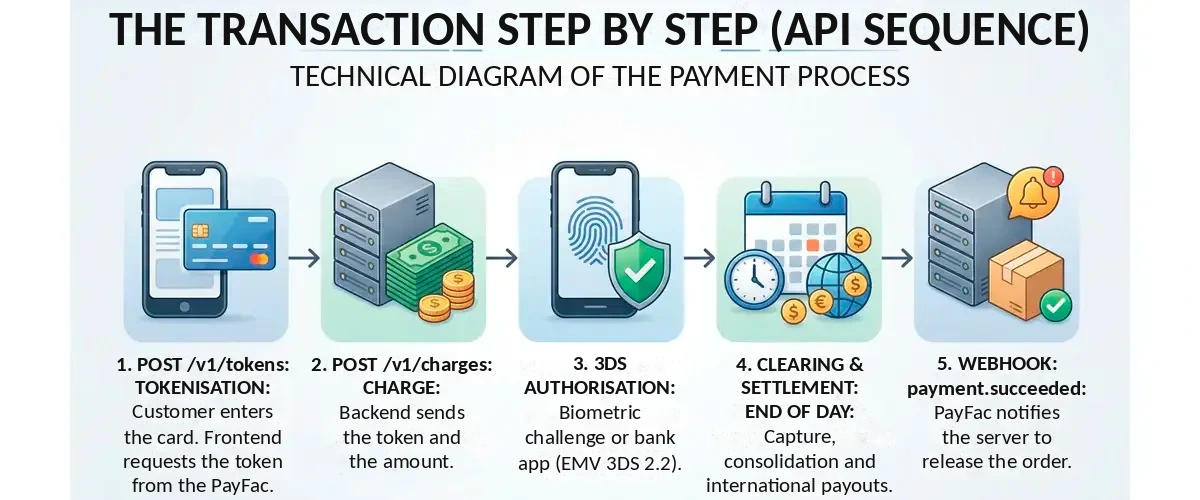
The typical API sequence in a PayFac follows this order:
- POST /v1/tokens: the sub-merchant’s frontend requests card tokenization from the facilitator.
- POST /v1/charges: the sub-merchant’s backend sends the token and the amount in cents.
- 3DS authorization: the facilitator orchestrates the biometric or banking‑app challenge using EMV 3D Secure 2.2.
- Clearing and settlement: at end of day, the transaction is captured and consolidated into the settlement batch.
- Confirmation webhook: the facilitator asynchronously notifies the sub-merchant’s server so the order can be released.
 Security layers in the process
The infrastructure of a payment facilitator operates with multiple layers of simultaneous protection:
- Multichannel tokenization: raw card data never resides in the merchant’s databases.
- P2PE encryption (Point-to-Point Encryption): data is encrypted from the user’s keypad to the acquirer.
- Real-time transactional scoring: algorithms evaluate velocity checks (repetitive attempts) and IP geolocation against the card.
- Continuous audits: semiannual penetration tests and access reviews based on the principle of least privilege.
Regulatory compliance: PSD2, PCI-DSS, 3DS and fraud prevention
Obligations under PSD2 and SCA
Directive (EU) 2015/2366 (PSD2) mandates Strong Customer Authentication (SCA) for electronic payments in the European Economic Area. This requires validating the payment using two out of three factors: something the user knows (PIN), something they possess (mobile device) and something they are (biometrics).
In Spain, the transposition is implemented through Royal Decree-Law 19/2018, which designates the Bank of Spain as the competent authority. The sanctions regime is severe: fines of up to 10% of annual net turnover or 5 million euros for very serious infringements.
For a payment facilitator, PSD2 compliance is not optional. It requires safeguarding sub-merchant funds in segregated accounts, applying automated KYC/KYB policies and maintaining auditable records of every operation for a minimum of six years.

PCI-DSS certification levels and what they mean for merchants
The PCI-DSS v4.0 standard (Payment Card Industry Data Security Standard) defines four certification levels based on annual transaction volume. A payment facilitator processing significant volumes must certify the most demanding level: SAQ-D, which requires a full annual audit by a QSA (Qualified Security Assessor).
The advantage for merchants: by operating under a certified facilitator, the sub-merchant drastically reduces its PCI scope. It does not store, process or transmit card data. Its only responsibility is to correctly integrate the tokenized form.
3DS2: minimal friction, minimal fraud
The EMV 3D Secure 2.2 protocol allows the facilitator to send contextual data (device, IP, purchase history) to the issuing bank so it can evaluate risk in real time. If the risk is low, the transaction flows without additional challenge.
An advanced payment facilitator implements SCA exemptions based on TRA (Transaction Risk Analysis). The key is calibrating the rule engine: applying 3DS only when risk justifies it and using exemptions when the trust signal is high. This balance can recover up to 15% of sales that would otherwise be lost due to unnecessary friction.
Fraud model of a payment facilitator in practice
PayFacs apply automated KYC/KYB policies from the moment of onboarding. When a sub-merchant registers, we consume PEP (Politically Exposed Persons) databases and sanctions lists (OFAC) in real time, in accordance with the Spanish Anti‑Money Laundering Law 10/2010.

At the transactional level, our engine combines deterministic rules (velocity checks, blocklists, AVS/CVV consistency) with human review for ambiguous signals. If a sub-merchant triggers risk alerts (abnormal billing spikes or a chargeback ratio above the 1% required by Visa and Mastercard), preventive holds are applied before the issue escalates.
Payment facilitator in action: sector-specific use cases
E-commerce retail: average ticket, volume and chargebacks
E-commerce with an average ticket between €30 and €150 is the natural scenario for the PayFac model. Transaction volume justifies automated onboarding and flat fees simplify financial forecasting. The facilitator manages the optimized checkout, applies SCA exemptions for low amounts and centralizes chargeback defense with standardized evidence.
B2B services and recurring billing
In the B2B space, the facilitator’s payment gateway integrates with ERP systems to automate recurring collections. Tokenization allows securely storing the customer’s card and executing periodic charges without requiring the cardholder to re-enter their details. The automatic card updater prevents declines due to expiration, an issue affecting 15–20% of active subscriptions each year.
Subscription platforms and freemium models
SaaS platforms converting free users into paying subscribers need a frictionless payment process. The payment facilitator provides an embedded checkout that captures the card at the moment of conversion, applies smart retries if the first charge fails and executes preventive dunning (reminders with one‑click payment method updates).
Marketplaces and split payments
This is where the payment aggregator model shines. If a cart contains products from three different sellers, the facilitator’s API engine splits the original charge and instantly settles the commission to the platform and the net amount to each seller.
There is a critical regulatory nuance: if you operate a marketplace and receive third‑party funds into your operational account before paying them out, you are providing payment services without a license. The impact is severe: regulatory fines and banking blockage. Using a licensed payment facilitator shields the marketplace from this risk. Funds flow from the card networks into the facilitator’s safeguarded environment, which then settles to the final seller.
PayFac vs. traditional models: why sub-acquiring wins
Real cost comparison
| Criterion | Payment facilitator | Traditional bank |
|---|---|---|
| Onboarding | Automated, activated within hours | Manual, weeks or months |
| Setup cost | Zero | Security deposits + opening fees |
| Integration | REST APIs, native SDKs, ready‑to‑use plugins | Redirect to external gateway (Redsys/CECA) |
| Pricing model | Flat blended rate, predictable | Interchange++ (efficient from €10–15M annually) |
| Settlement | T+1 or instant (SCT Inst) | T+2 to T+7 depending on the bank |
| Fraud management | Integrated engine with parametric rules | Externalized or non‑existent |
| Contractual relationship | Single provider for the entire lifecycle | Fragmented (bank + external technical gateway) |
| Risk and liability | The facilitator acts as a risk shield | Risk falls directly on the merchant |
Advantages of a payment facilitator over a traditional bank
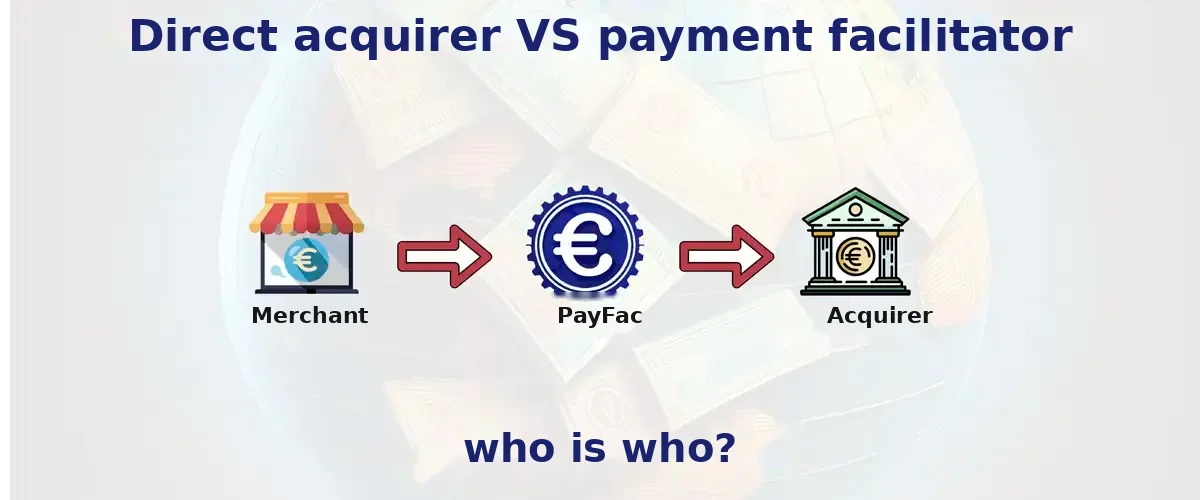
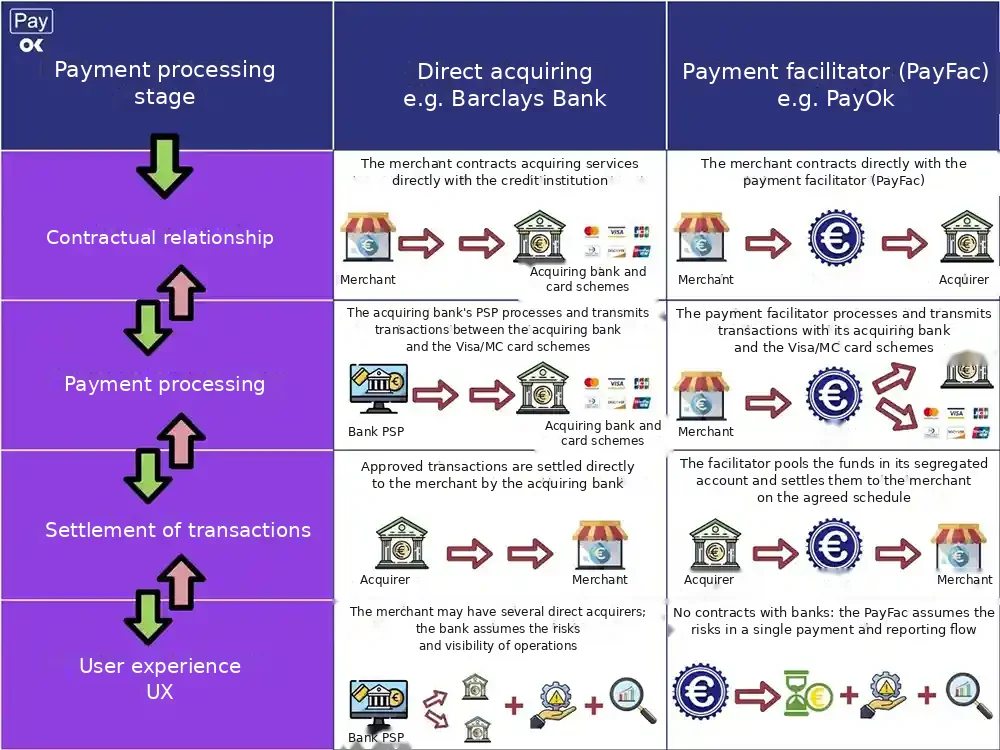
- Onboarding in hours, not weeks. The merchant completes a digital form, passes automated KYC/KYB verification and receives production credentials in under 24 hours. With a bank, the same process involves notarized documents, manual review and timelines of 20 to 30 days.
- Zero setup cost and no security deposits. The PayFac model removes economic barriers to entry. There are no opening fees, no fixed monthly maintenance charges and no upfront deposits required to start processing.
- Modern, unified API integration. A single provider covers gateway, acquiring, fraud prevention, tokenization and reconciliation. With a bank, the merchant must contract an external technical gateway (Redsys, CECA) and manage both relationships independently.
- Centralized fraud management. The payment facilitator executes velocity checks, transactional scoring, blocklists and SCA exemptions from a single engine. The merchant does not need to contract or configure additional fraud tools.
- Fast settlements. T+1 cycles and even instant payments (SCT Inst), compared to the typical T+3 to T+7 of the banking circuit. For a business with tight margins, this difference in cash flow is critical.
- Immediate scalability. If the platform needs to onboard 50 new sellers in a week (for example, during a commercial campaign), the sub‑acquiring model allows it without individual negotiations with the bank.
- Risk shield. Card scheme penalties (Visa, Mastercard) for excessive chargebacks fall first on the facilitator, not directly on the sub‑merchant. The merchant operates with an additional layer of protection.
Disadvantages of payment facilitators you should know
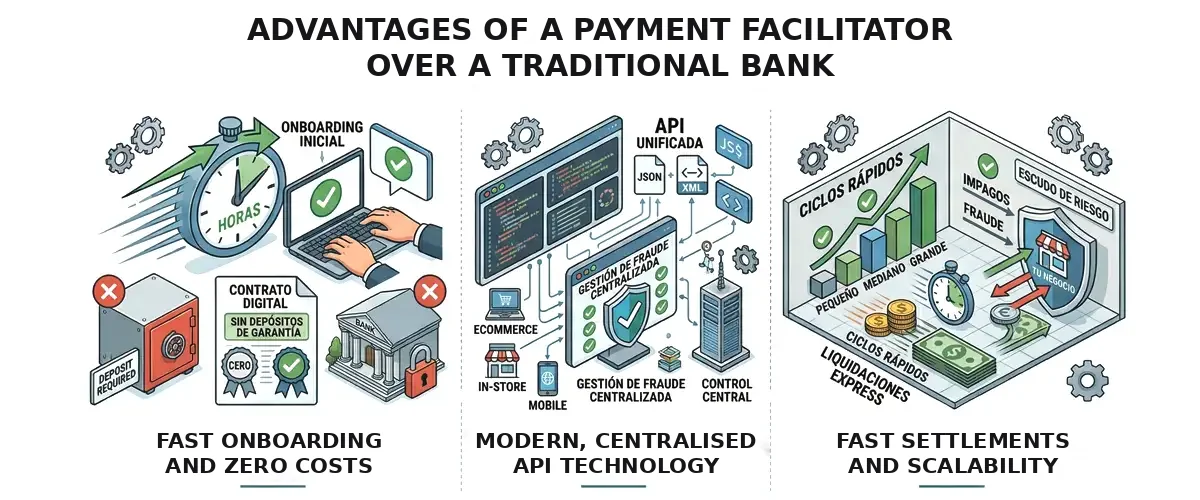
- Standardized pricing (flat rate). The blended model is predictable, but for merchants processing more than €10–15 million annually, a directly negotiated Interchange++ model with the acquirer may be cheaper per transaction.
- PayFac risk control over your account. The facilitator applies its own risk matrix. If the chargeback ratio exceeds the 1% required by the schemes or abnormal spikes are detected, the facilitator may apply preventive holds or even suspend the account. The merchant depends on the PayFac’s internal policies.
- Dependence on the facilitator’s infrastructure. If the facilitator’s reconciliation system or gateway experiences downtime, the merchant’s treasury visibility is interrupted. With a direct banking contract, the merchant has independent access to the bank’s systems.
- Less customization for large accounts. Bank acquirers offer tailored negotiation for large retailers: special rates by BIN, issuing country or card type. The PayFac model, by standardizing, loses that pricing granularity.
- Brand perception. Some high‑profile corporate merchants prefer a direct relationship with a bank for image or internal compliance reasons. The sub‑acquiring model does not always fit the internal policies of large corporations.
Advantages of traditional banks over payment facilitators
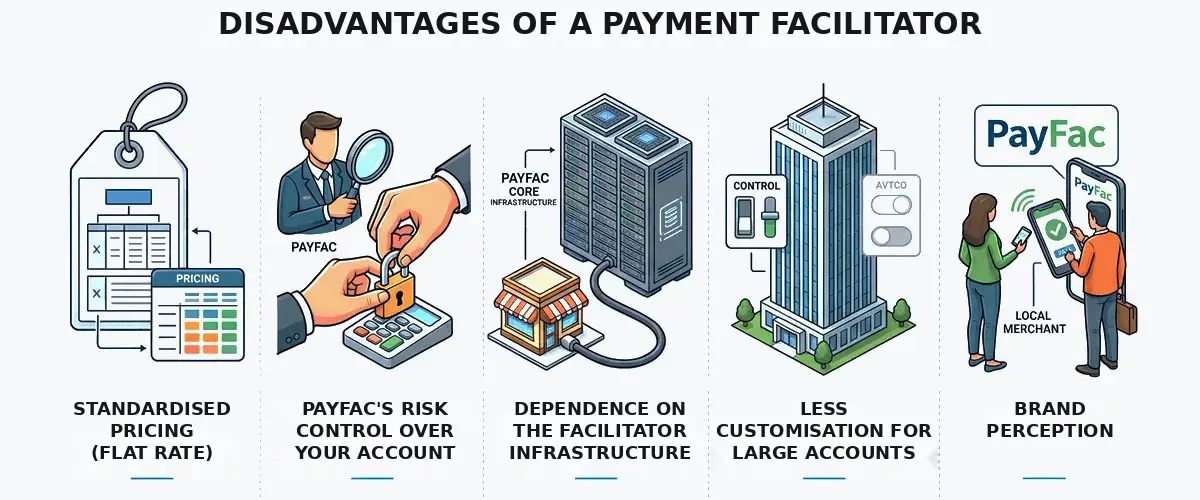
- Highly negotiable pricing at large volumes. The Interchange++ model allows merchants processing more than €15 million annually to obtain very competitive rates, especially on European cards regulated by Regulation (EU) 2015/751.
- Direct institutional relationship. The merchant has its own MID with the card schemes. It does not depend on the risk decisions of an intermediary.
- Robust legacy infrastructure for in‑person payments. Bank acquirers dominate the physical channel (POS terminals). For merchants with a strong in‑store component and low online volume, the bank may be the most natural option.
Disadvantages of traditional banks that hinder digital commerce
- Slow and bureaucratic onboarding. Notarized documents, manual review, security deposits and timelines of 3 to 8 weeks. For a startup or platform that needs to scale quickly, these timelines are unworkable.
- Fragmented integration. The bank provides the MID, but the technical gateway is managed by a third party (Redsys, CECA). The merchant must coordinate two providers with different SLAs and support channels.
- Slow settlements. T+1 to T+7 cycles that immobilize working capital. For a business operating with 5–10% margins, financing a week of sales with its own funds directly impacts profitability.
- Reactive support. Banking support teams are not designed to resolve real‑time gateway incidents. A failed payment on a Saturday night is not resolved until Monday.
Settlement speed and cash‑flow control
The settlement cycle is where payment processing directly impacts the merchant’s treasury. In a classic banking model, the acquirer settles in T+3 to T+7. This means the merchant finances three to seven days of sales with its own operating capital.
The payment facilitator typically settles in T+1 cycles and offers the possibility of instant payments via SEPA Instant Credit Transfer (SCT Inst). For a merchant with monthly revenue of €100,000, moving from T+5 to T+1 permanently frees approximately €16,000 in working capital.
Advantages of the Payment Institution model over a payment aggregator
Most payment facilitators in the market operate under third‑party licenses or simply act as technological intermediaries. Payment facilitators have direct control over the safeguarding and reconciliation chain.
This translates into concrete advantages: we do not depend on outages in obsolete core banking systems for reconciliation. Merchant funds are segregated under our direct supervision. And the relationship with the premium acquirer that grants us access to the card schemes is managed under service‑level agreements that guarantee redundancy and operational continuity.
Payment infrastructure as a competitive advantage
Payments are no longer a simple accounting formality. In 2026, the collection infrastructure is the factor that determines the growth speed of a digital business. Whoever controls their payment flow controls their treasury, their conversion and their ability to scale.
If your platform needs to onboard merchants at scale, manage split payments without clashing with Bank of Spain regulations or simply stop losing sales due to an obsolete checkout, the traditional model won’t work. You need a facilitator with a financial license, modern API architecture and an obsession with authorization rate.
Want to audit your current payment architecture? Contact the PayOk team for a free diagnostic session. You can schedule directly at filling in the Contact us form or call +34 968 079 125.
- The direct acquirer is connected to the card schemes (Visa, Mastercard) and issues independent MIDs for each merchant. The payment facilitator operates under a Master Account with an acquirer and sub‑aggregates merchants under its umbrella. The result for the merchant: instant onboarding, no banking bureaucracy and centralized management of fraud and disputes.
- If the facilitator is regulated as a Payment Institution, merchant funds are held in segregated safeguarding accounts with full legal protection. PCI‑DSS certification, PSD2 SCA and AML/CFT policies are mandatory and audited periodically.
- Complete digital onboarding (KYC/KYB, document verification and credential provisioning) is executed in under 24 hours for low‑risk merchants. Compared to the 3–6 weeks typical of the traditional banking circuit.
- European regulation (PSD2) and its Spanish transposition (RDL 19/2018, Article 21) require customer funds to be deposited in segregated safeguarding accounts. In case of insolvency, merchants have absolute separation rights over those funds against any creditor.
- The PayFac model is especially efficient for merchants processing between €5,000 and €500,000 per month. Below that range, the facilitator remains the most accessible option. Above €10–15 million annually, negotiating a direct Interchange++ model with the acquirer may be interesting, although the facilitator still adds value in onboarding, fraud prevention and reconciliation.
- If the marketplace receives funds from buyers and distributes them to sellers, it is providing payment services. Without its own license or without operating through a regulated payment facilitator, that activity is illegal. The Bank of Spain’s fines for unauthorized provision of payment services are the most severe in the sanctions regime.
- Credit and debit cards (Visa, Mastercard, JCB, UnionPay), tokenized recurring payments, split payments for marketplaces, one‑click payments, in‑app payments and SEPA transfers. The scope depends on the configuration of the premium acquirer the facilitator works with.
Was this post useful?
1 of 1 I found it useful

Leave a Comment
Ready to get started?
Create your PayOk account in minutes. No maintenance fees, pay per transaction.