
E-Commerce audit: 20 Essential steps for Fraud Prevention
- Digital Fraud Prevention: 20 critical steps to shield your E‑commerce and protect your cash flow
- What digital fraud prevention is and why it defines your profitability today
- The real impact of digital fraud prevention on conversion, cash flow and margin
- Technical architecture: how digital fraud prevention works behind the scenes
- Regulatory compliance: PSD2, PCI‑DSS, 3DS and fraud prevention
- Digital fraud prevention in action: sector‑specific use cases
- Payment facilitators vs generic aggregators: why the regulated PayFac model wins
Digital Fraud Prevention: 20 critical steps to shield your E‑commerce and protect your cash flow
Your e‑commerce business is losing money right now — and you probably don’t know it. For every euro a fraudster steals through cloned cards or identity spoofing, your business loses the product cost, shipping expenses, customer acquisition cost, and the chargeback penalties imposed by the acquiring bank. The real financial impact multiplies to 3.5 times the original fraud amount.
As the CEO of an entity regulated by the Bank of Spain, I’ve seen viable businesses suffocate due to the absence of a serious digital fraud prevention protocol. This article is not academic theory. It is the exact protocol we apply in the operational trenches to protect our merchants’ revenue.
By the end of this guide, you will master:
- The 20 technical, legal and operational controls that separate a hardened e‑commerce from a vulnerable one.
- How proper online store security boosts conversion instead of slowing it down.
- The European regulatory framework (PSD2, PCI‑DSS, GDPR) applied to real prevention, not decorative compliance.
- The difference between delegating your payments to any aggregator or working with a regulated payment facilitator that understands your business and knows the sector’s real problems.

What digital fraud prevention is and why it defines your profitability today
Technical definition: what a CTO understands
Digital fraud prevention is a multilayer system of automated and manual controls that validate the legitimacy of every transaction before, during and after processing. This is not about installing a plugin and forgetting about it. It involves inspecting cryptographic certificates (TLS), validating domains (WHOIS), testing payment API calls, correlating device signals, and geolocating IPs against risk lists.
At the architectural level, it means verifying that the data transport layer, PAN tokenization, and payment gateway routing operate under standards that are unbreakable for unauthorized third parties.
Business definition: what matters to the merchant
From a C‑Level perspective, digital fraud prevention is the barrier separating a profitable business from one classified as a high‑risk merchant by card networks. When fraud penetrates your ecosystem due to weak controls, Visa and Mastercard place you in their monitoring programs (such as Visa’s VAMP). This triggers massive fund holds — the so‑called Rolling Reserves — which can freeze your cash flow for months.
An unresolved e‑commerce fraud incident doesn’t just cost the fraud amount. It costs your risk classification, higher fees, and in the worst case, termination of your acquiring contract.
We operate under the supervision of the Bank of Spain and require our merchants to maintain auditable architectures compliant with the European Payment Services Directive (PSD2), the General Data Protection Regulation (GDPR), and the PCI‑DSS v4.0 standard. Every euro processed must come from a legitimate and traceable source.
The real impact of digital fraud prevention on conversion, cash flow and margin
Industry data and operational reality
There is a dangerous myth: that security creates friction and kills sales. Our daily operational reality shows the opposite. A robust and transparent online store security infrastructure increases conversion because it reduces buyer anxiety at the critical payment moment.
The data is clear: users abandon up to 70% of carts when they detect anomalies during checkout. Displaying a secure architecture with tokenized payment methods and extended validation (EV) certificates accelerates purchase decisions.
How digital fraud prevention reduces cart abandonment
Abandonment is not always about price. Often the buyer perceives risk signals they cannot articulate: an unprofessional payment form, missing verification seals, or a checkout redirecting to unknown domains. Each of these triggers the user’s instinct for self‑protection.
Proper implementation of 3D Secure 2 with intelligent exemptions (low‑value, TRA) allows authentication only when risk justifies it. This reduces friction without compromising security. Payment facilitators apply SCA dynamically: we authenticate when there is real risk and allow frictionless flow when issuer signals are positive.

Direct impact on merchant cash flow
Every chargeback you receive costs more than the transaction amount. Card networks apply escalating penalties. If your chargeback ratio exceeds 1% of sales, you enter monitoring programs that may result in fines of €50,000–€250,000 and loss of card‑acceptance capability.
A serious digital fraud prevention program protects cash flow from three angles: it reduces chargebacks, eliminates unjustified fund holds, and keeps your risk classification at levels that allow competitive fees.
Technical architecture: how digital fraud prevention works behind the scenes
Step‑by‑step data flow: The 20 most critical controls
The analysis must begin — non‑negotiably — at the network layer. Fraudsters automate the creation of fake stores but often neglect the underlying architecture due to cost. Here are the 20 steps we apply, organized by layer.
Layer 1: Technical infrastructure (Steps 1–5)
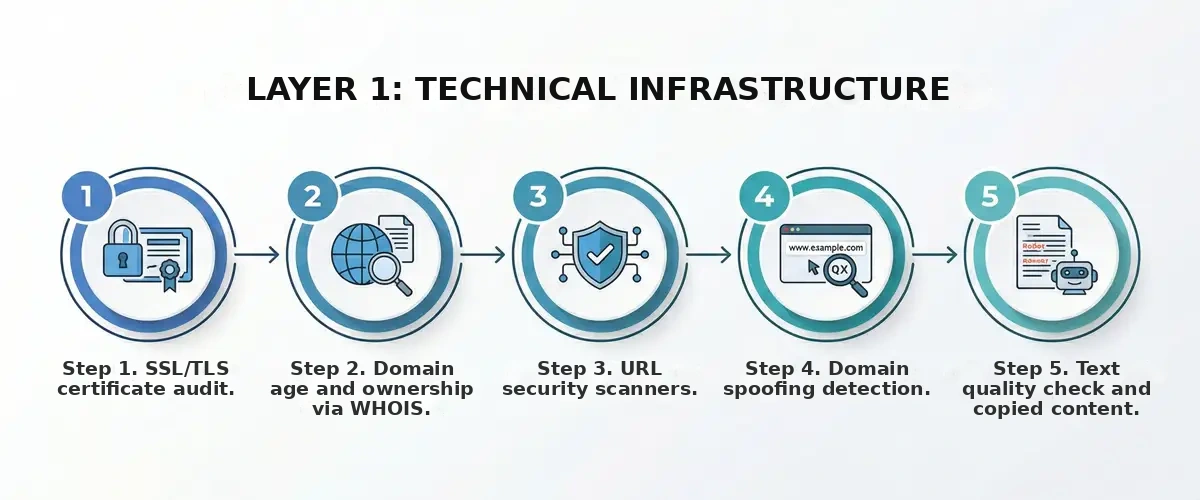
Step 1 – SSL/TLS certificate audit. Don’t rely on the green padlock. Inspect the Certificate Authority (CA). A basic free certificate (Domain Validation) with a 30‑day expiry is common in fraudulent stores. Require Organization Validation (OV) or Extended Validation (EV) certificates for any platform processing payments.
Step 2 – Domain age and ownership analysis via WHOIS. Check the domain registration date and the hosting Autonomous System Number (ASN). A merchant claiming ten years of experience but whose domain was registered 45 days ago through an anonymous proxy is an obvious scam.
Step 3 – URL security scanners. Run the address through tools like VirusTotal, urlscan.io or Google Transparency Report. These platforms cross‑reference the domain against dozens of phishing and malware blacklists in real time.
Step 4 – Domain spoofing detection. Analyze the URL string for homoglyph characters (Cyrillic characters that look Latin) or subtle substitutions. Criminal networks clone well‑known brands and host them on visually identical domains.
Step 5 – Grammatical quality analysis and detection of copied content. Illicit platforms are generated through automated scraping and unsupervised mass translations. Look for broken code tags ([insert_company_name]), mixed currencies, or robotic translations. A legitimate e‑commerce business invests in content quality control.
Layer 2: Legal validation and transparency (Steps 6–11)
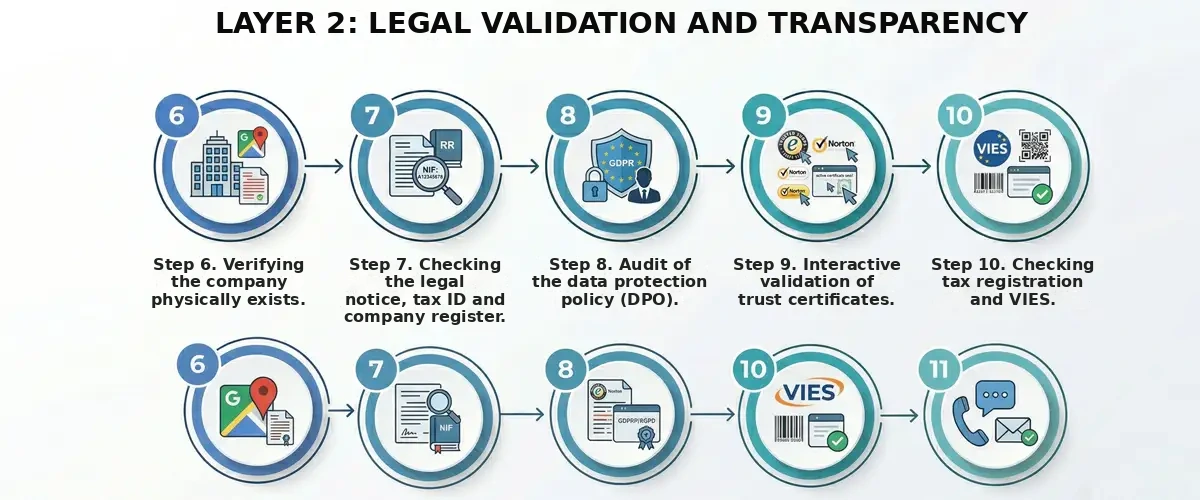
Step 6 – Verification of physical existence. Extract the postal address and cross‑check it with Google Street View and cadastral databases. Companies operating from PO boxes or generic virtual offices without a visible tax address are suspicious.
Step 7 – Scrutiny of legal notice and terms & conditions. Look for the full legal entity name, tax ID, and commercial registry details. Without this information, the company has no legal existence before the regulator, and recovering funds in a dispute will be impossible.
Step 8 – Privacy policy and data‑processing audit. Verify GDPR compliance (Regulation EU 2016/679). Generic policies copied from free generators that do not specify the Data Protection Officer or the exact processing of payment data are illegal and highly suspicious.
Step 9 – Interactive validation of trust seals. Seals must be active links pointing to the auditor’s official domain showing the certificate in real time. A static image pasted in the footer is psychological manipulation.
Step 10 – Verification in official registries. Enter the tax identifier in the European Commission VIES system. This instantly confirms whether the company exists, is active, and is authorized for cross‑border trade.
Step 11 – Direct contact test. Before purchasing, open a support ticket or call customer service. Fraudulent e‑commerce networks operate with margins that do not allow real support teams. If the phone number doesn’t exist or emails bounce, abort the operation.
Layer 3: Market signals and social proof (Steps 12–16)
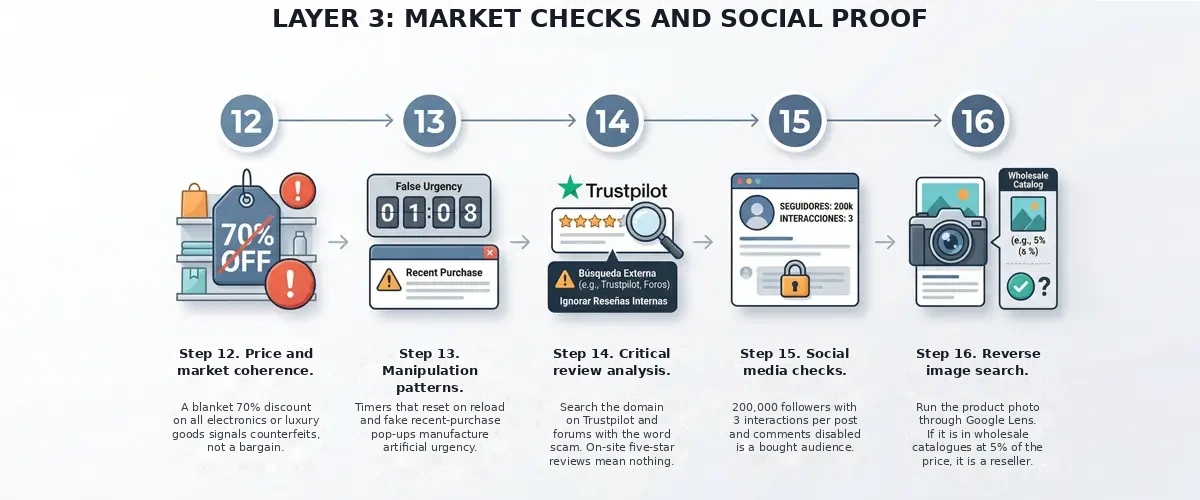
Step 12 – Price evaluation and market consistency. Site‑wide 70% discounts on electronics or luxury fashion are not bargains. They are mathematical certainty of counterfeit products or non‑existent shipments.
Step 13 – Detection of manipulation patterns. Countdown timers that reset on page reload or fake “recent purchase” notifications are designed to override analytical thinking through artificial urgency.
Step 14 – Critical review analysis. Search the domain on Trustpilot or specialized forums adding the word “scam”. Ignore five‑star reviews hosted on the seller’s own domain — they are easily manipulated.
Step 15 – Social media investigation. A profile with 200,000 followers but only three interactions per post and disabled comments is a synthetic ecosystem purchased from automated profile farms.
Step 16 – Reverse image search. Download the main product image and run it through Google Lens or TinEye. If it appears in wholesale catalogs at 5% of the advertised price, you’re dealing with an opaque model with no quality control.
Layer 4: Payment chain security (Steps 17–20)
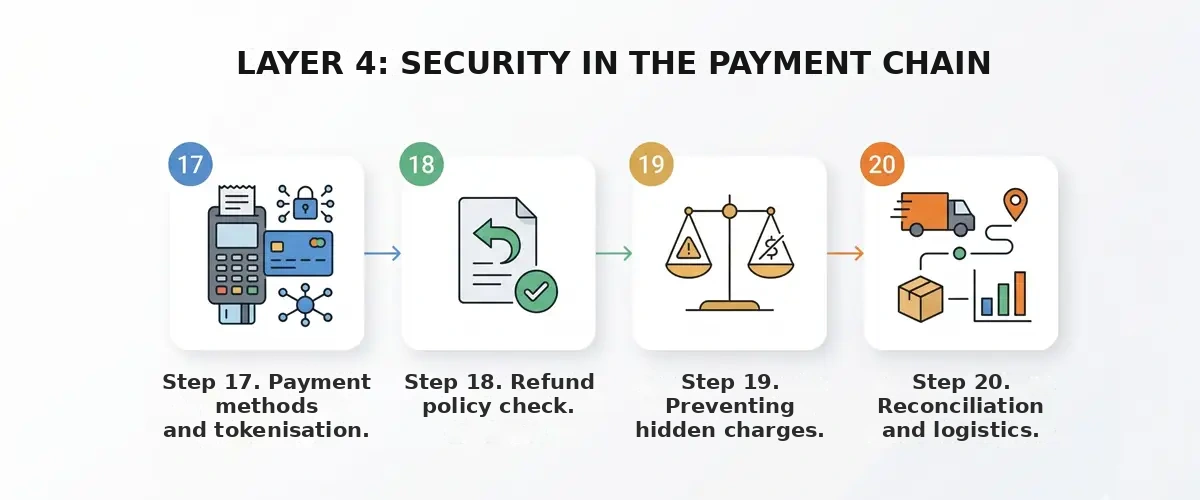
Step 17 – Inspection of payment methods and tokenization. Reject stores that require direct bank transfers to offshore jurisdictions or cryptocurrencies as the only method. Require credit cards or digital wallets (Apple Pay, Google Pay) that use tokenization and allow chargeback procedures.
Step 18 – Verification of return policies. In the European Economic Area, the law requires a 14‑day right of withdrawal without justification. If the policy states that all sales are final or forces returns to Asian addresses with the buyer covering costs, it is an intentional barrier.
Step 19 – Hidden‑fee prevention. Simulate the purchase process up to the last step before entering the card number. Sudden additions of processing fees or mandatory shipping insurance violate transparency regulations in payments.
Step 20 – Reconciliation monitoring and logistics traceability. The bank descriptor (the name shown on your statement) must match the website. If you buy from “Zapatos Madrid” and the charge appears as “Xuzhou Tech Ltd.”, you’ve been subjected to unauthorized cross‑border processing.
API integrations and infrastructure requirements
REST vs SDK: when to use each
For digital fraud prevention integrations in your e‑commerce, choosing between direct REST API or the provider’s SDK depends on your level of control. The REST API offers maximum flexibility: you build each call, control retries, and handle errors your way. It is the option for technical teams experienced in payments.
The SDK simplifies integration at the cost of less granularity. It is ideal for merchants who need to go live quickly and delegate retry logic to the provider. We offer both options with full documentation and dedicated testing environments.
Asynchronous notifications and event management
Your system must listen to gateway events in real time. An authorized payment that is not captured, a refund left pending, or a chargeback not responded to in time are silent money leaks. Configure notification receivers for every critical event: authorization, capture, decline, chargeback, and refund.
Security layers in the process

Security is not a single wall. It is a system of concurrent layers working in parallel:
- Tokenization: replaces the real PAN with an alternate identifier. If a breach occurs, exposed data is useless outside the system.
- Blocklists and velocity controls: block high‑risk BINs, IPs and devices. Limit attempts per card, amount and frequency.
- Hybrid monitoring: combines deterministic rules with human review. Simple signals such as consistent AVS and CVV, geolocated IP, and corporate email increase transaction confidence.
Regulatory compliance: PSD2, PCI‑DSS, 3DS and fraud prevention
Obligations under PSD2 and SCA
The Payment Services Directive (EU) 2015/2366 – PSD2 introduced the obligation to apply Strong Customer Authentication (SCA) whenever a user accesses their payment account, initiates an electronic transaction, or performs any remote action involving fraud risk (Article 97 PSD2). In Spain, this directive was transposed through Royal Decree‑Law 19/2018.
The European Banking Authority (EBA) developed the Regulatory Technical Standards (RTS) specifying SCA requirements and exemptions. These rules have been directly applicable across the 27 Member States since September 2019 and include nine exemptions, such as Transaction Risk Analysis (TRA) and low‑value payments.
If a store processes your payment without requiring two‑factor authentication (biometrics, SMS code or banking‑app OTP), it is operating with obsolete gateways. This is not only illegal — it shifts liability directly to the merchant, destroying them in the event of mass disputes.
PCI‑DSS certification levels and what they mean for merchants
The PCI‑DSS v4.0 standard defines 12 core requirements grouped into six categories: network security, cardholder data protection, vulnerability management, access control, monitoring, and security policy.
Any serious store delegates card processing to PCI‑DSS Level 1 payment institutions. This means that when the user enters their card, the data never touches the merchant’s server. It is sent directly to the acquirer’s cryptographic vault, which returns a secure token. The merchant never stores, processes or transmits real card data.
PCI‑DSS levels are classified by annual transaction volume. Level 1 (over 6 million transactions) requires an annual audit by a certified QSA (Qualified Security Assessor). Levels 2 to 4 allow Self‑Assessment Questionnaires (SAQ), but protection obligations remain equally strict.
3DS2: minimal friction, minimal fraud
The 3D Secure protocol in its version 2 (EMVCo specification) allows issuers to make risk‑based decisions using enriched device data, geolocation, cardholder history and merchant signals. When risk is low, authentication happens in the background with no visible friction for the buyer.
The EMV payment token extension for 3DS (published by EMVCo) allows issuers to use additional token data to improve authentication decisions. This reduces the need for extra verification steps such as one‑time codes or biometrics, improving approval rates without compromising security.
Digital fraud prevention in action: sector‑specific use cases
Physical‑goods e‑commerce (average ticket, volume, chargebacks)
Physical‑goods merchants face classic card‑not‑present (CNP) fraud. The attacker buys with a stolen card, receives the product, and the legitimate cardholder initiates a chargeback. The main defense is combining 3DS2 with signed proof of delivery, a recognizable bank descriptor, and fast support response.
For average tickets above €150, we recommend always enforcing strong authentication. The conversion cost is minimal compared to the cost of a chargeback on high‑value products.
B2B services and recurring billing
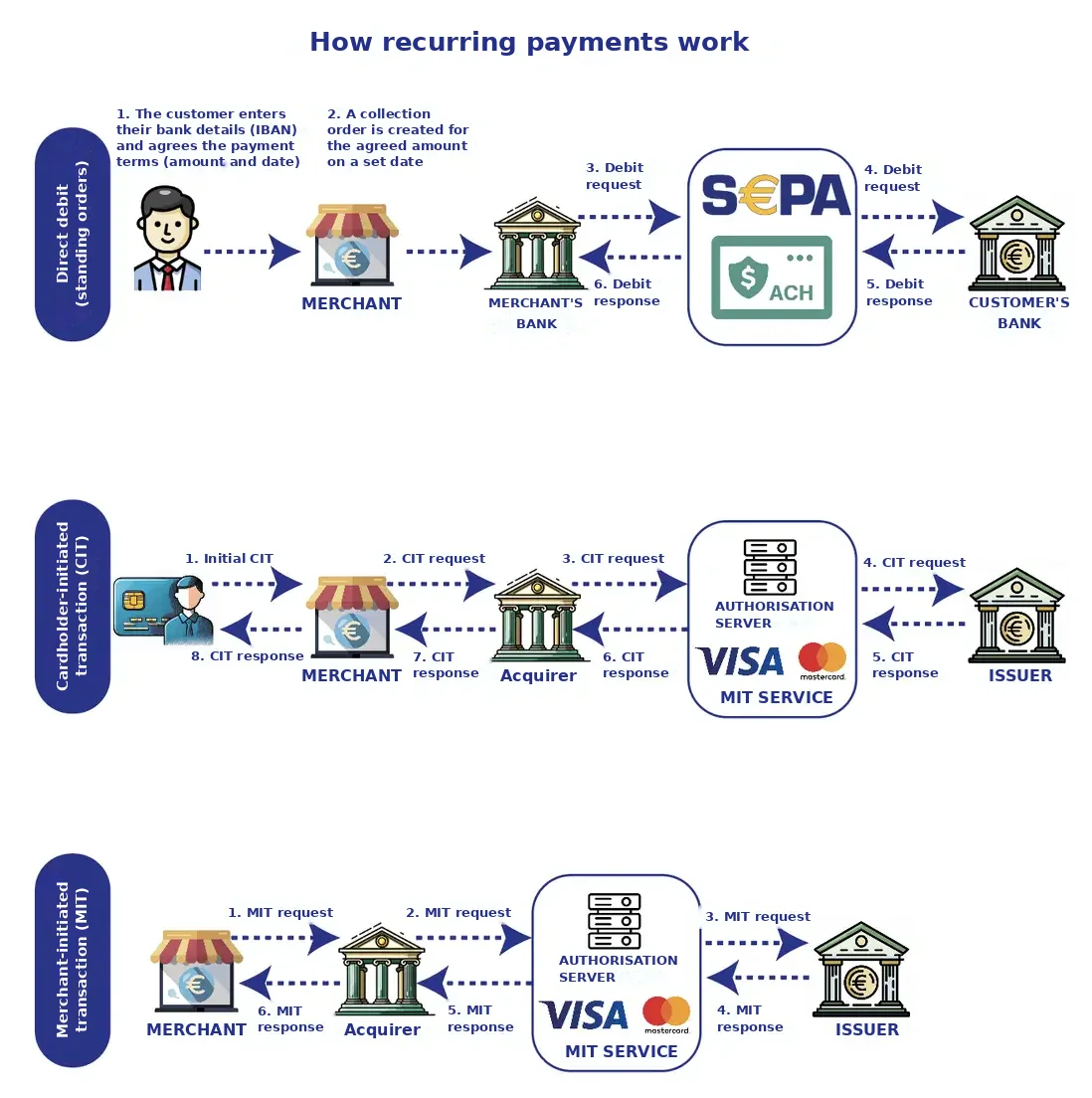
In B2B, risk shifts toward merchant‑initiated transactions (MIT). Tokenization is essential: storing tokens instead of real card data enables secure recurring billing. Each retry uses the token and a dynamic cryptogram validated by the network before authorization.
The regulatory challenge is correctly classifying the first transaction (CIT — customer‑initiated with SCA) and subsequent ones (MIT — exempt from SCA if properly documented).
Subscription platforms and trial‑based models
Subscriptions are fertile ground for friendly fraud: the user subscribes, consumes the service, then files a chargeback claiming they don’t recognize the charge. Prevention requires clear bank descriptors, proactive communication before each billing cycle, and a portal where customers can manage their plans and payment methods without involving the bank.
Multi‑vendor platforms and split payments
When you operate as a payment facilitator for third‑party sellers, fraud risk multiplies. You must implement identity and business verification (KYC/KYB) for each seller, monitor discrepancies between declared and actual activity, and establish alerts for transactional laundering: a seller claiming to sell clothing but processing payments typical of digital services is an immediate red flag.
Payment facilitators vs generic aggregators: why the regulated PayFac model wins
Real cost comparison
As a payment facilitator regulated by the Bank of Spain, we aggregate merchants under our umbrella and manage processing through acquiring banks with direct connections to card networks (Visa, Mastercard). We are not a direct acquirer connected to the schemes. We are the partner that understands your business, manages your risk, and gives you access to payment infrastructure without requiring you to contract acquiring services on your own.

This difference is critical compared to mass aggregators that onboard you in five minutes but treat you as just another number.
| Feature | Generic Aggregator | Regulated PayFac |
|---|---|---|
| Knowledge of your business | Automated onboarding with no business‑model analysis | Onboarding with KYB, vertical analysis and risk profiling |
| Sub‑merchant management | Shared credentials under a generic MID | Segmented sub‑merchant credentials under the PayFac umbrella |
| Fraud control | Generic shared rules | Custom risk engine per merchant |
| Fund blocking during disputes | Full freeze until resolution | Proportional management based on sub‑merchant risk |
| Dispute management | Automatic notification with no guidance | Centralized management with precise instructions and deadlines |
| Data visibility | Black box with no transparency | Real‑time dashboards and reconciliation |
Settlement and cash‑flow control under the PayFac model
When a mass‑market aggregator blocks your funds at the first dispute, it does so because it has not evaluated your business model nor has visibility into your operations. By performing complete onboarding with KYB verification, vertical analysis and limits aligned with your real risk, we can settle faster and without unjustified holds.
Our model as a payment facilitator means we manage the relationship with the acquiring bank on your behalf. You don’t need to negotiate contracts with banks or understand the complexity of network infrastructure. We take on that layer and give you access to card payments quickly, under regulation, and with real operational support.
Advantages of the PayFac model vs. aggregators without local regulation
The PayFac model provides three critical advantages over aggregators operating from foreign jurisdictions:
- Local regulation by the Bank of Spain (license BE 6928), with merchant funds safeguarded in segregated accounts held at regulated credit institutions.
- Centralized dispute and chargeback management with clear instructions, deadlines and technical narratives that connect data with business facts to defend your case before the issuer.
- Risk engine tailored to your vertical, configuring velocity controls, blocklists, amount and frequency limits, and continuous monitoring aligned with your real risk profile.
Industry studies put it at around 3 to 4 times the amount of the fraudulent transaction. On top of the stolen amount you lose the product, shipping costs, customer acquisition cost and the chargeback fee your provider charges. Your risk rating with the card networks also gets worse.
For most payments, yes. PSD2 and the EBA technical standards require Strong Customer Authentication (SCA) for most online card payments in the EEA, and 3D Secure is how it is applied. There are exemptions, such as low-value payments and transaction risk analysis (TRA), and they must be applied correctly. Merchant-initiated transactions (MIT) fall outside SCA, as long as the first payment was authenticated.
It depends on your annual card transaction volume. Most online stores fall into levels 3 or 4 and validate compliance with a Self-Assessment Questionnaire (SAQ). If you use your provider's payment page or hosted fields, card data never touches your servers and your PCI scope is much smaller. Check that your payment provider is PCI DSS compliant and ask for its certificate.
Use the checks in this guide. The quickest warning signs are a recently registered domain (check WHOIS), no legal notice with a tax ID and company registration details, prices far below the market, and bank transfer or crypto as the only payment options.
Network tokenization (such as Visa Token Service or Mastercard MDES) replaces the card number with a token issued by the card network and adds a unique cryptogram to each transaction, which the network checks. Traditional tokenization protects the card number in your provider's systems, but the network still receives the real card number. Network tokens usually give better security and higher approval rates.
As a practical baseline, review technical controls every quarter: vulnerability scans, certificates and fraud rules. Run a full review once a year covering infrastructure, compliance and processes. Your annual PCI DSS validation is a good moment to do it.
Yes. When security checks are proportional to risk, more legitimate payments are approved and fewer customers abandon checkout. With 3DS2 and good contextual data, most low-risk payments go through without the customer having to do anything.
Was this post useful?

Leave a Comment
Ready to get started?
Create your PayOk account in minutes. No maintenance fees, pay per transaction.