
Cashless payments: The definitive 2026 guide
- Cashless payments: The definitive technical guide for E‑commerce and Marketplaces
- What cashless payment is and why it defines your profitability today
- The real impact of cashless payments on conversion, cash flow and margin
- Cashless payments in action: sector‑specific use cases
- Payment facilitator vs traditional models: where the real difference lies
- Cashless payment is no longer a competitive advantage. It is the minimum standard.
- Sources and related reading
Cashless payments: The definitive technical guide for E‑commerce and Marketplaces
Does your store have a 68% conversion rate? The question few ask is whether the remaining 32% represents a lack of interest or simply technical friction. In most e‑commerce platforms I review, the answer is the latter: 3DS that doesn’t load, unavailable payment methods, a gateway that takes five seconds to respond, an unrecognizable bank descriptor. Technical problems that the marketing team calls “abandonment” and the payments team should call “money left on the table”.
This guide is not written for someone who wants to understand the concept of cashless payments. It is written for the CTO and the technical lead of an e‑commerce operation who need to implement it correctly, with European regulatory grounding, real data, and no euphemisms about what each architectural decision costs in conversion and liquidity.
By the end of this guide, you will master:
- The real architecture of a cashless payment and its infrastructure implications.
- The quantified impact on conversion, cash flow and operating margin.
- The concrete obligations of PSD2, PCI‑DSS and 3D Secure Protocol on your integration.
- Why the direct acquiring model outperforms the classic aggregator in control and cost.
What cashless payment is and why it defines your profitability today
Cashless payment is any monetary transaction executed without the physical transfer of banknotes or coins. Technically, it involves message exchanges between four entities: the merchant (acceptor), its acquiring bank, the card scheme network, and the buyer’s issuing bank.
There is a critical distinction the market often confuses. Authorization is a promise: the issuer freezes the funds and returns an approval code, but the money has not moved yet. Settlement (clearing and settlement) is when the money actually travels, in overnight batches, typically between T+1 and T+3 days in most European schemes.
Confusing both phases is not a semantic mistake. It is a real cash‑flow risk. A merchant who assumes the money is available on the day of authorization and receives a refund request before settlement has a liquidity hole that will not appear in any dashboard.
Main cashless payment methods in 2026
The cashless ecosystem in Spain and Europe operates on six technical pillars:
- Contactless NFC card – in‑person payments, EMV protocol.
- Virtual POS and CNP payments (card‑not‑present) via API – e‑commerce channel.
- Digital wallets: Apple Pay, Google Pay, Bizum – native network tokenization.
- SEPA Instant Credit Transfer (SCT Inst) – settlement in under ten seconds.
- Dynamic QR with card schemes or Bizum – in‑person and remote use.
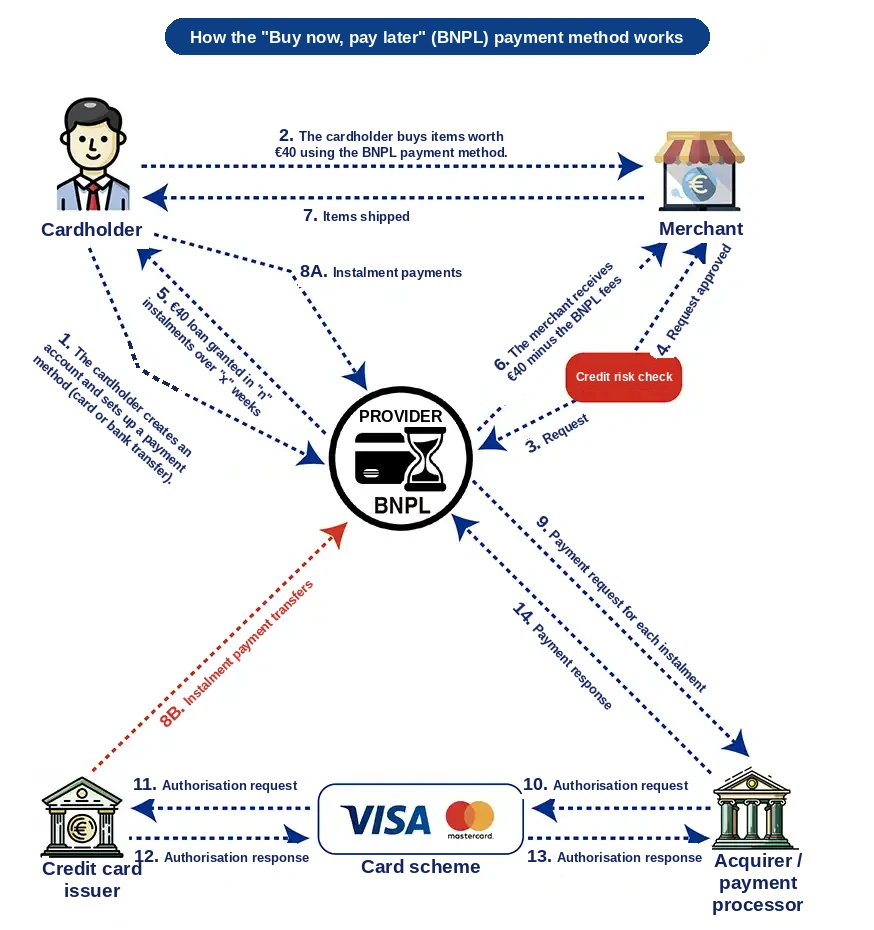
- BNPL (buy now, pay later): Klarna, Scalapay, Aplazame – credit embedded in the checkout flow.
The invisible cost of poor implementation
Industry data for the Spanish market in 2025–2026 is consistent: between 15% and 25% of abandoned carts in e‑commerce are not due to purchase intent, but to technical friction. Unavailable payment methods, 3DS that doesn’t load, excessive waiting time, a bank descriptor that triggers distrust. Each of these failures has a technical owner, not a marketing owner.
The real impact of cashless payments on conversion, cash flow and margin
Data that turns payment architecture into a financial decision
These are the parameters I analyze when reviewing a merchant’s integration:
- A Virtual POS integration with off‑site redirection reduces conversion by 15% to 20% compared to an in‑site or iframe integration.
- The average ticket with Apple Pay or Google Pay is 12% to 18% higher than manual card entry on mobile, because it removes the friction of typing 16 digits on a small screen.
- Enabling digital wallets on mobile increases authorization rates by 4 to 7 percentage points, because network tokens score better in issuer risk models than raw card numbers.
- Every unnecessary extra authentication step in 3DS costs between 5% and 8% conversion, according to data published by the European Banking Authority (EBA).
The four real technical causes of checkout abandonment
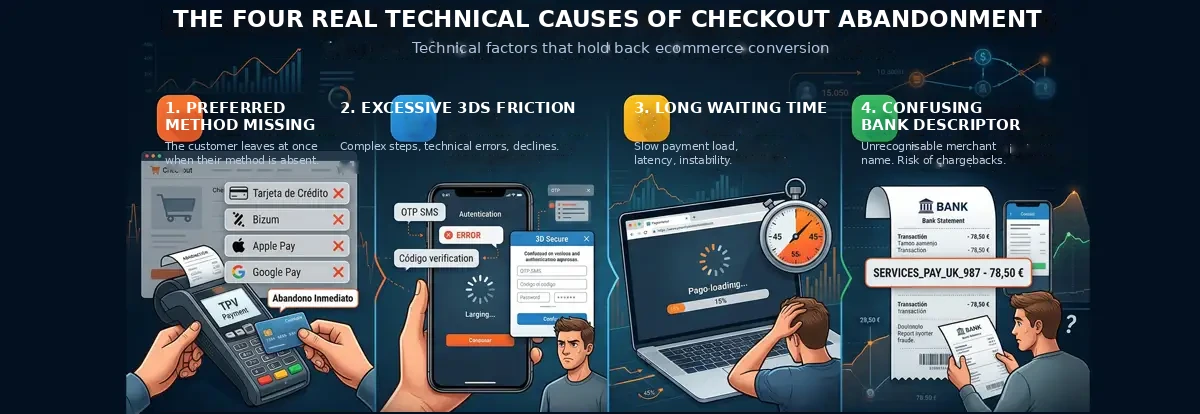
Checkout abandonment is not psychological. It is technical. Concrete causes, in order of frequency:
- Lack of the preferred payment method. The user reaches checkout and cannot find Bizum, Apple Pay or their usual wallet. Instant abandonment, no second chance.
- Excessive 3DS friction. One‑time codes on every transaction without applying exemptions or adaptive risk analysis. Every extra step is lost conversion.
- High waiting time. A gateway taking more than three seconds to respond generates statistically significant abandonment on mobile.
- Confusing bank descriptor. The name on the customer’s statement does not match the store. This triggers calls to the bank, card blocks and “unrecognized” chargebacks.
Direct impact on cash flow: what nobody negotiates but everyone pays
With a traditional bank‑type acquirer, average settlement is T+1 to T+3 with a variable rolling reserve depending on the contract. With acquiring through a regulated entity, settlement can be negotiated at T+1 or even same‑day for certain merchant profiles.
The difference for an e‑commerce business with €500,000/month in revenue can represent €30,000 to €50,000 in additional liquidity permanently in circulation, without external bank financing. The rolling reserve is the percentage the processor retains as collateral. It ranges from 5% to 10% of volume for 90–180 days and is negotiable from the first contract. Most merchants sign it without questioning it. Reducing or eliminating it for low‑risk profiles is financial work, not technical work.
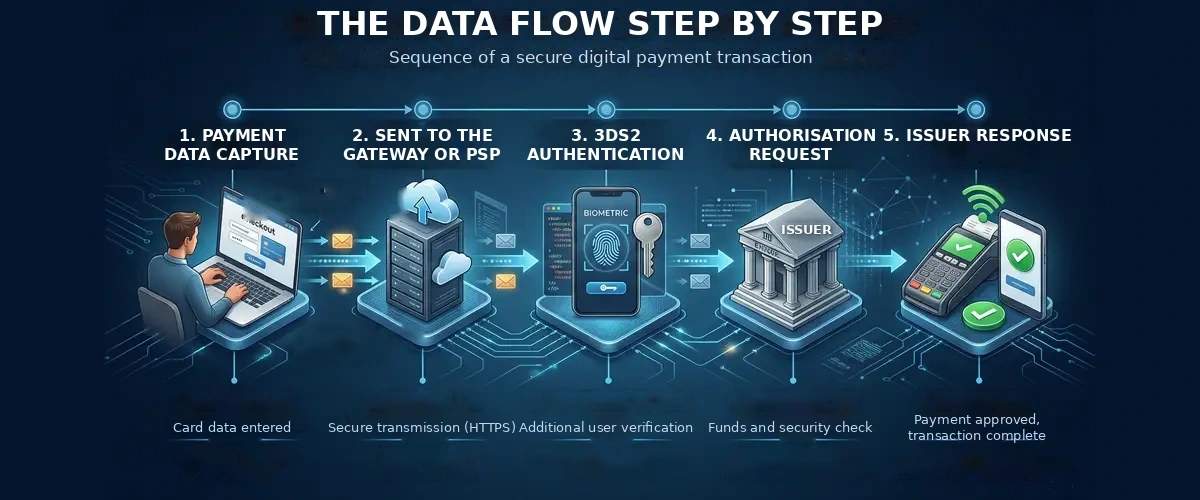
What the user sees as “one click to pay” is a chain of messages that takes between one and four seconds. Each step has a potential failure point, and system robustness depends on how many of those points are monitored in real time.
The step‑by‑step data flow
- Payment data capture. The browser or app tokenizes the card before transmitting it. The card number should never touch your servers if network tokenization is implemented correctly.
- Sending to the gateway or PSP. Encrypted data travels to the payment processor via HTTPS with TLS 1.2 or higher.
- 3DS2 authentication (if applicable). The issuer evaluates risk using more than 100 variables. If an exemption applies, the flow is frictionless and the user sees no additional screen. If not, a one‑time code or biometric challenge is triggered.
- Authorization message. The gateway sends the request to the acquirer, which forwards it to the scheme network, which routes it to the issuer.
- Issuer response. Approval (code 00), decline with reason code, or referral to the bank.
- Capture and settlement. The merchant confirms capture. Between T+1 and T+3 the settlement process is executed.
3DS2 vs 3DS1: the difference is not the version — it is the intelligence
While 3DS1 sent 15 fields to the issuer for risk evaluation, 3DS2 sends over 100 elements: device type, browser fingerprint, transaction history, typing speed in the form, geolocation, and user behavior patterns.
The result: the issuer can approve most legitimate transactions in a frictionless flow, without the user seeing any additional screen. In well‑configured 3DS2 integrations with adaptive risk analysis, the percentage of frictionless transactions exceeds 75–85% of the total.
The most common mistake: merchants with 3DS2 integrated but automatically falling back to 3DS1 for issuers that “don’t respond well”. The result is paying the friction cost of 3DS1 (universal one‑time code) without the risk‑intelligence benefits of 3DS2.
Cashless payments in action: sector‑specific use cases
Retail e‑commerce: architecture based on average ticket size
The average order value defines the optimal architecture. Optimizing for €25 is not the same as optimizing for €350:
- Low ticket (under €50). Prioritize native digital wallets (Apple Pay, Google Pay) for maximum speed and automatic network tokenization. Apply the low‑value exemption whenever the amount allows it. Friction in this range destroys conversion more than in any other segment.
- High ticket (over €200). You need well‑calibrated 3DS2, strong proof of delivery and a defensive chargeback policy. In this range, friendly fraud—customers claiming they never received the product when they did—can exceed actual fraud.
- Seasonal peaks (Black Friday, holidays). Relying on a single processor is documented operational negligence. Redsys has had outages on Black Friday. A two‑hour outage in an e‑commerce business generating €100,000/day means €8,333 in direct loss. The cost of redundant infrastructure is marginal compared to that risk.
Marketplaces and split payments: technical and regulatory complexity
Marketplaces face an additional complexity that generic solutions do not handle well: the money does not go to a single recipient. Split payments between platform and sellers require the architecture of a Payment Facilitator or a sub‑merchant structure under a primary acquirer. The critical technical considerations are:
- Correct MCC code for each sub‑merchant. An incorrect MCC can trigger authorization failures or unnecessary risk reviews.
- Deferred settlement. Holding settlement to the seller until delivery is confirmed. This requires explicit processor support and is not standard in all contracts.
- Mandatory KYB. Under PSD2 and AML regulations, every marketplace seller must pass business verification. Without this, the platform assumes the risk of illicit activity within its network.
- Cascading chargebacks. When the buyer disputes a transaction, the chargeback hits the marketplace, not the seller. The recovery process must be contractually defined at seller onboarding, not after the first incident.
If your chargeback rate exceeds 1% of monthly volume, card schemes can place you in monitoring programs, impose additional reserves or even terminate your acquiring contract. This is not theoretical — it happens.
Payment facilitator vs traditional models: where the real difference lies
Cost comparison under the PayFac model
The IC++ (Interchange Plus Plus) model transparently separates the three components of total processing cost. The flat‑rate model hides them inside a single number that looks simple but becomes expensive as volume grows:
| Component | Flat rate (traditional banking) | Payment Facilitator |
|---|---|---|
| Interchange (EU‑regulated) | Included with no visibility | Declared by card type |
| Scheme fees (Visa/Mastercard) | Included with no visibility | Declared and auditable |
| Acquirer margin | Hidden inside the global percentage | Explicitly negotiated |
| Full transparency | No | Yes |
| Optimizable by volume and card type | No | Yes |
| Auditable by the merchant | No | Yes |
Settlement speed and cash‑flow control
With traditional banking (Redsys as card capture processor):
- Standard settlement: T+1 or T+3 business days.
- Rolling reserve: common, between 5% and 10%, held for 90–180 days.
- Real‑time visibility: minimal or none.
- Reconciliation: manual or via spreadsheet exports.
With PayFac‑model acquiring through a regulated entity:
- Negotiable settlement: T+1 or same‑day depending on merchant profile.
- Rolling reserve: negotiated from the first contract, reducible to zero for low‑risk profiles.
- Real‑time control panel: authorization rate by BIN range, country and device.
- Automated reconciliation integrable with the merchant’s ERP system.
Aggregator comparison: Stripe, Adyen and Redsys
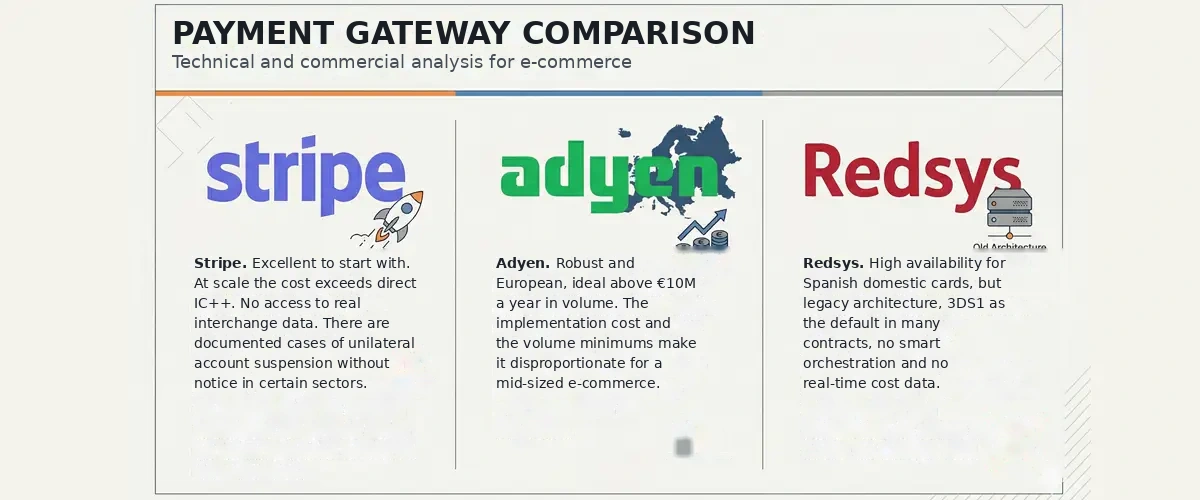
- Stripe. Excellent for getting started. At scale, costs exceed direct IC++. No access to real interchange data. Documented risk of unilateral account suspension without prior notice in certain industries.
- Adyen. Robust and European, ideal for merchants processing over €10M/year. Implementation cost and volume minimums make it disproportionate for mid‑sized e‑commerce businesses.
- Redsys. High availability for Spanish local cards, but legacy technical architecture, 3DS1 as default in many contracts, no intelligent orchestration and no real‑time cost‑data visibility.
The payment‑facilitator acquiring model through a regulated financial institution provides what no aggregator can: full control of financial data, merchant‑level configuration flexibility, directly negotiated settlement, and access to real cost data by card type and BIN range.
Cashless payment is no longer a competitive advantage. It is the minimum standard.
Merchants operating with legacy gateways, without tokenization, without digital wallets and without real‑time monitoring are losing between 15% and 30% of their potential conversion in every checkout session today.
If you want to know exactly where the problem lies in your current integration, there are professionals specialized in acquiring and digital payments who perform that diagnosis with real data: authorization rate by BIN range, PCI scope, 3DS configuration and cost comparison against your current processor. Request a free diagnostic
Legal and regulatory framework
- Royal Decree‑Law 19/2018 of 23 November on payment services and other urgent financial measures .
- Commission Delegated Regulation (EU) 2018/389 — Regulatory Technical Standards (RTS) on Strong Customer Authentication (SCA).
- Law 10/2010 of 28 April on the prevention of money laundering and terrorist financing (AML/CFT) .
- Regulation (EU) 2016/679 (GDPR) — General Data Protection Regulation, applicable to the processing of cardholder data.
The gateway is the technical component that securely captures the payment data and transmits it to the processor. The acquirer is the regulated financial institution that processes the transaction, holds the contractual relationship with Visa and Mastercard, and settles the funds into your bank account. They can be the same provider or two separate entities. Working with a provider that integrates both functions removes an intermediary layer, reduces costs and simplifies daily reconciliation.
Not for every payment. PSD2 requires SCA on remote card payments, but there are regulated exemptions that can keep most of your transactions free of additional authentication: low-value payments under €30, trusted beneficiaries, transaction risk analysis (TRA) within the thresholds your fraud rate allows, and merchant-initiated recurring payments. A correct technical integration applies these exemptions automatically. Without that configuration you are adding friction you have regulatory grounds to avoid.
You lose every sale for as long as the outage lasts. There is no mitigation without a second active acquirer or an orchestrator configured to reroute traffic automatically. Redsys and other processors have suffered outages on high-volume dates. In an e-commerce business billing €100,000 a day, a two-hour outage means roughly €8,333 in direct losses. The cost of redundancy is marginal next to that risk.
It depends on the processing model. With traditional banking (Redsys, commercial banks), standard settlement is T+1 to T+3 business days. With direct acquiring through a regulated entity, settlement can be negotiated at T+1 or even same-day, depending on the merchant's risk profile. The rolling reserve, the percentage held as collateral, also affects your available liquidity and is fully negotiable before you sign, not afterwards.
Directly and measurably. Digital wallets (Apple Pay, Google Pay) use network tokens and achieve higher authorisation rates than raw card numbers, because the issuer receives a lower-risk signal. Bizum runs on direct bank transfer and reaches authorisation rates close to 99%. Corporate and international cards are lower by default. Monitoring your authorisation rate by method, BIN range and issuing country is the fastest lever for improving conversion without touching a single line of checkout code.
A chargeback happens when the cardholder disputes the transaction with their bank. The merchant loses the sale amount, the acquirer's dispute fee and, if the goods were already shipped, the product as well. When your chargeback ratio crosses the schemes' thresholds, they can place you in a monitoring programme, impose additional reserves or terminate your acquiring contract. The most effective defence combines solid delivery evidence, the purchase IP address, address verification and a clear, recognisable descriptor on the customer's bank statement.
- Card tokenisation: no card numbers on your servers, PCI scope minimised.
- 3DS2 with adaptive risk analysis: not 3DS1, and not 3DS on every transaction; exemptions configured correctly with your PSP.
- Idempotent event handling: never confirm an order on the basis of the user's redirect alone.
- At least two alternative methods: Bizum, Apple Pay or Google Pay alongside cards.
- Acquirer redundancy: a second active provider, or an orchestrator with automatic failover.
- A real-time monitoring dashboard: authorisation rate, decline codes and PSP latency.
- A consistent merchant descriptor: the name on the bank statement must be recognisable to the customer.
Was this post useful?

Leave a Comment
Ready to get started?
Create your PayOk account in minutes. No maintenance fees, pay per transaction.