Interchange fees: how Visa and Mastercard make money and who pays each fee
- Interchange fees: how Visa and Mastercard make money and who pays each fee
Interchange fees: how Visa and Mastercard make money and who pays each fee
You charge €100 by card and €99 lands in your account. That missing euro does not go to a single company: it is split between your customer's bank, the card network, and your payment provider. The central piece of that split is the interchange fee, and understanding it is the best way to know what accepting card payments really costs you and which part you can negotiate.
What is the interchange fee
The interchange fee is the fee the acquiring bank pays to the issuing bank every time a card payment is made. Put simply: it is what your customer's bank earns for having issued the card, authorising the transaction, and taking on the risk that the cardholder does not pay.
To understand it, you need to know the four players of the so-called four-party model, which is how Visa and Mastercard work:
| Player | Who it is | What it does in every payment |
|---|---|---|
| Cardholder | Your customer | Pays with their debit or credit card |
| Merchant | You | You sell and receive the money, minus the fee |
| Issuing bank | Your customer's bank | Authorises the payment and takes on the non-payment risk |
| Acquiring bank | Your payment provider (a bank or a licensed payment institution) | Accepts the payment on your behalf and settles the money to you |
Visa and Mastercard do not appear in the table because they are not banks: they are the card schemes. They set the rules and run the technological network that connects the issuing bank with the acquirer, and thanks to that network a card issued in Germany can pay in a shop in Murcia within a couple of seconds.
Who receives the interchange fee: the issuing bank, not Visa
It is the most repeated mistake in the industry, even in training material: thinking that the interchange fee is Visa's or Mastercard's business. It is not. The schemes define it in their rules, but the full amount goes to the issuing bank. The fact that the Visa or Mastercard brand appears on your terminal receipt does not mean they keep that fee.
The legal cap on interchange fees in the European Union
In Europe, the interchange fee is not unrestricted. Regulation (EU) 2015/751 sets a maximum for consumer cards issued and used within the European Economic Area (EEA):
| Card type | Legal cap | On a €100 purchase |
|---|---|---|
| Consumer debit or prepaid card | 0.2% | €0.20 at most |
| Consumer credit card | 0.3% | €0.30 at most |
| Business or corporate card | No legal cap | Variable, usually considerably higher |
| Card issued outside the EEA | No legal cap | Variable, with international surcharges |
| Three-party schemes (American Express) | These caps generally do not apply | Set by the brand itself |
That is why, if you sell to customers outside Europe or charge companies paying with corporate cards, your average cost per transaction goes up and there is no legal cap protecting you.
How Visa and Mastercard really make money
If the interchange fee is not theirs, where does their business come from? First, what they do not do, because it explains many misconceptions:
- They do not issue cards. Banks do.
- They do not lend money or collect credit interest.
- They do not take on the cardholder's non-payment risk.
Visa and Mastercard do not make money by lending to you: they earn a little every time a card moves through their network. These are their revenue streams.
Scheme and processing fees
They charge issuing and acquiring banks a small fee on the volume that flows through their network, and another for each transaction they process (authorisation, clearing, and settlement). Per transaction it is a matter of cents, but multiplied by billions of payments a year it forms the core of their business. These scheme fees are the part of your fee that does end up with Visa or Mastercard.
International transactions and currency conversion
When the card and the merchant are in different countries, or the payment is made in a currency other than the card's, additional surcharges apply. It is one of their most profitable lines of business, and one of the reasons why charging foreign customers costs more.
Value-added services
Services sold on top of the network carry more and more weight: anti-fraud tools, card tokenization, payment authentication, data analytics, and cybersecurity. The technology behind 3D Secure, which protects online purchases, is part of this ecosystem.
Summary: where each player makes its money
| Player | Revenue source |
|---|---|
| Issuing bank | Interchange fee + credit interest + card fees charged to the holder |
| Visa and Mastercard | Scheme fees, processing, international surcharges, and services |
| Acquiring bank or payment institution | Its margin within the fee charged to the merchant |
| Merchant | Earns nothing: pays a fee in exchange for being able to sell by card |
Who pays the card payment fee and how it is split
The merchant pays it. That total fee is called the Merchant Discount Rate or MDR, and it is the figure you see in your contract and your settlement statements. It is built like this:
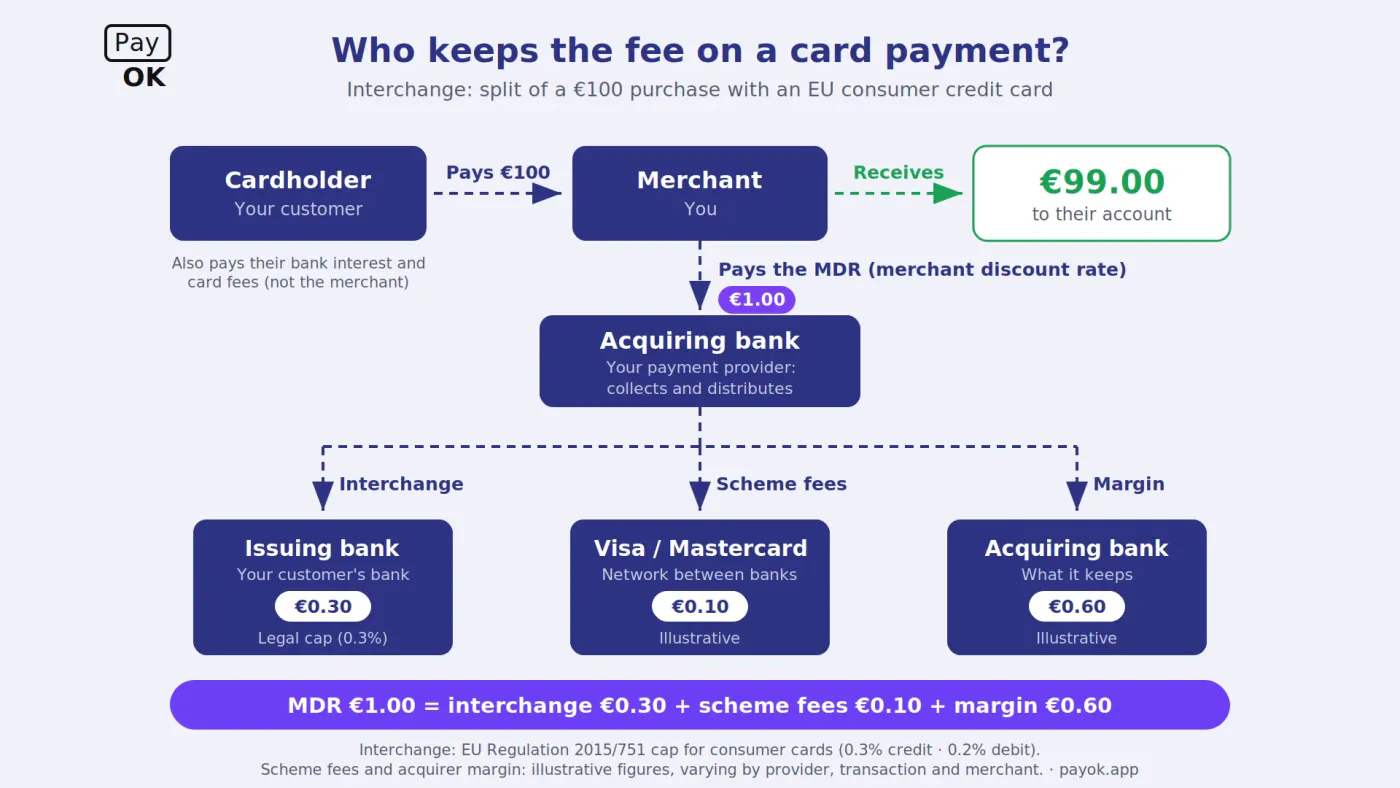
Let's look at the split in a European example: a Spanish customer pays €100 with their credit card in a Spanish online store.
| Item | Who receives it | Amount |
|---|---|---|
| Purchase price | — | €100.00 |
| Interchange fee | Issuing bank | €0.30 (legal cap) |
| Scheme fees | Visa or Mastercard | €0.10 (illustrative) |
| Acquirer margin | Acquiring bank or payment institution | €0.60 (illustrative) |
| MDR | — | €1.00(illustrative) |
| What the merchant receives | — | €99.00 |
With a debit card, the interchange fee would be €0.20 at most. The only component capped by law is the interchange fee: scheme fees depend on the transaction type, and the acquirer margin is the only genuinely negotiable part.
When you get charged: authorisation and settlement are not the same
When your customer pays, the transaction is authorised within seconds: the issuing bank reserves the balance. But the actual money moves later, during clearing and settlement between banks, usually in overnight processes, and that is where the interchange fee is applied. The hold on your customer's card can last several days. It is worth keeping that gap in mind so you do not mix what has been authorised with what has been received in your cash flow, especially if a refund happens before the settlement arrives.
Flat rate or Interchange++: which suits you?
Providers charge the MDR in two ways:
| Model | How it works | Advantage | Drawback |
|---|---|---|---|
| Flat rate | A single percentage for all payments | Simple and predictable | You cannot see which part is interchange and which is margin |
| Interchange++ (IC++) | Actual interchange + actual scheme fees + provider margin, all itemised | Transparent: you pay the real cost of each card | A more complex, variable invoice |
Neither is bad in itself: a flat rate can be the best option for a low-volume business. The problem appears when your sales mix is mostly domestic debit (0.2% interchange) and you pay a high fixed percentage: in that case you are overpaying margin without knowing it. Always ask for the breakdown when comparing offers: it is the only way to know which part is the legal cap, which part goes to Visa or Mastercard, and which part you can negotiate.
Factors that make your fee higher
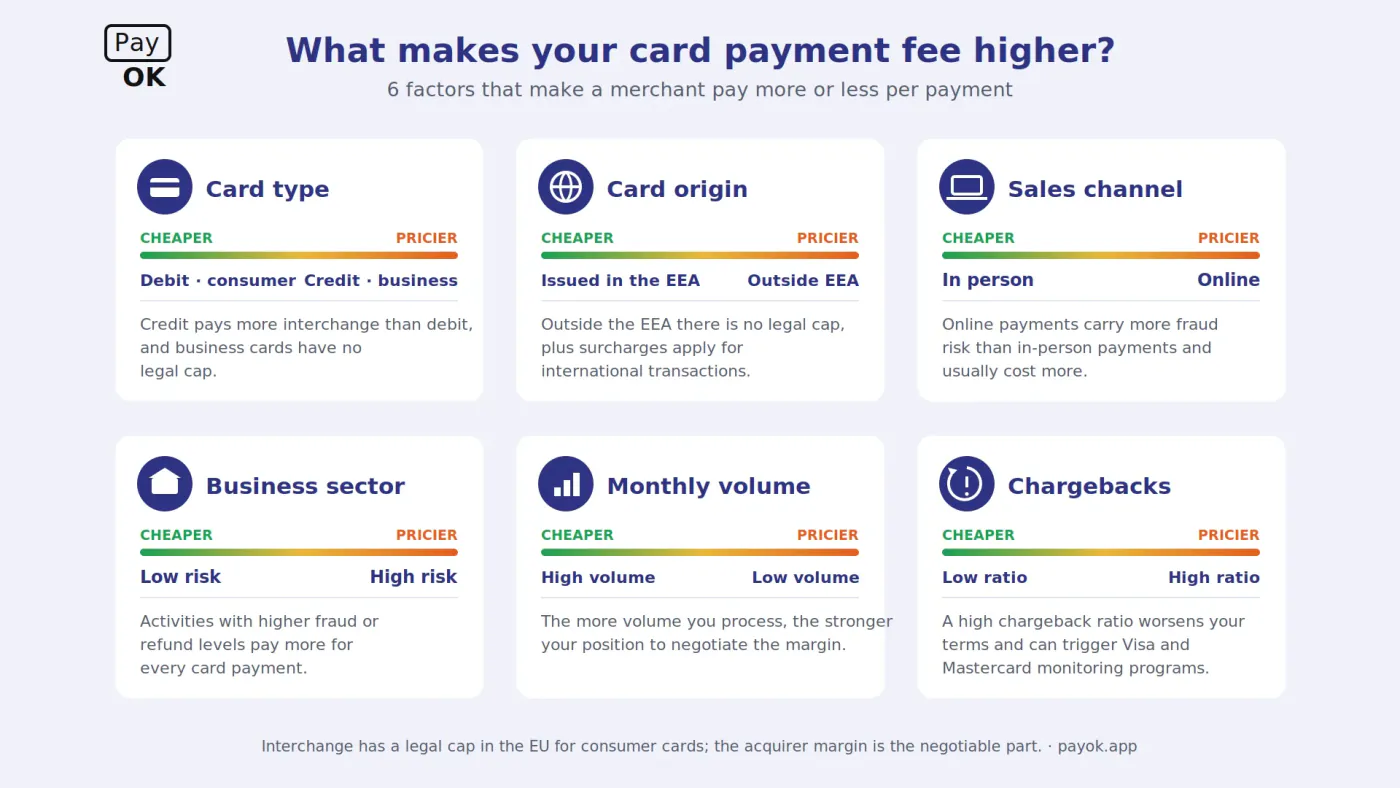
- Card type: credit is more expensive than debit; business more expensive than consumer.
- Card origin: outside the EEA there is no legal cap.
- Channel: an online payment carries more fraud risk than an in-person one and usually costs more.
- Sector: higher-risk activities pay more.
- Monthly volume: the more volume, the stronger your position to negotiate the margin.
- Chargebacks: a high ratio worsens your terms and can trigger the schemes' monitoring programs — Visa's is VAMP (article in Spanish).
Typical situations by business type
- E-commerce with international customers. A good share of the cards fall outside the European cap and your average cost rises. Know where your customers come from before setting prices.
- B2B charging companies. Corporate cards have uncapped interchange, well above the 0.3% of a consumer card.
- Restaurants and local retail. Low average ticket and lots of domestic debit: the acquirer margin weighs proportionally more.
- Subscriptions and recurring payments. The first charge is authenticated with the customer present; the following ones run against a stored token. Without good management of those credentials, declines due to expired card data increase.
Can I add a surcharge for paying by card?
In most cases, no. The Payment Services Directive (PSD2), applied in Spain through Royal Decree-Law 19/2018, prohibits surcharging customers for paying with consumer cards subject to interchange fee caps. The fee on consumer cards is a cost of your business, not a supplement you can add at checkout.
The same PSD2 requires strong customer authentication (SCA) for most online payments, with exemptions for low amounts or low risk that a good provider applies without sacrificing sales. A poorly configured 3D Secure blocks legitimate purchases, and that hurts your bottom line more than the fee itself.
How to pay less on every card payment
- Know your card mix: what percentage is debit, credit, business, or foreign.
- Compare the margin, not the total percentage. Ask for the breakdown of every offer.
- Reduce fraud and chargebacks with strong authentication and good practices.
- Never touch card data yourself. Redirect the payment to a certified virtual POS or Payment gateway: you comply with PCI DSS without carrying its cost.
- Review your terms as your volume grows. If you are still unsure which provider you need, see how a payment facilitator (PayFac) simplifies onboarding and payments.
Accept card payments with a regulated provider
PayOk is a payment institution authorised and supervised by the Bank of Spain (code 6928). We help you accept card payments securely, with 3D Secure and PCI DSS compliance: card data is never stored on our servers.
Check our fees and find out which part of your current fee you might be overpaying.
We publish payment industry analysis and news on our LinkedIn page.
Sources
- Regulation (EU) 2015/751 of the European Parliament and of the Council on interchange fees for card-based payment transactions.
- Directive (EU) 2015/2366 (PSD2) and Royal Decree-Law 19/2018 on payment services.
- PCI DSS security standard of the PCI Security Standards Council.
- It is the fee the merchant's bank (acquirer) pays to the customer's bank (issuer) on every card payment. In the European Union it has a legal cap of 0.2% for consumer debit cards and 0.3% for consumer credit cards.
- No. The interchange fee goes entirely to the issuing bank. Visa and Mastercard earn scheme fees, processing fees, international surcharges, and value-added services — much smaller amounts per transaction.
- The merchant pays it, through the Merchant Discount Rate charged by their acquiring bank or payment institution. In the European Union it cannot be passed on to the customer as a surcharge when consumer cards are involved.
- It depends on the country, the card type, the transaction type, and the volume. Its fees are a small fraction of the amount, and there is no single public rate applicable to all cases.
- Because cards issued outside the European Economic Area are not subject to the cap of Regulation (EU) 2015/751 and usually generate surcharges for international transactions and currency conversion.
- The interchange fee is just one component, with a legal cap, and goes to the issuing bank. The Merchant Discount Rate is the total cost the merchant pays: interchange, scheme fees, and the acquirer margin.
- Not quite. American Express mostly operates as a three-party scheme: the same company issues the card and acquires the payment, so in general the interchange caps of the European Regulation do not apply to it.
Was this post useful?

Leave a Comment
Ready to get started?
Create your PayOk account in minutes. No maintenance fees, pay per transaction.