API Payment Gateway
What is a Payment gateway API? Definition and Financial concept
A payment gateway API is a set of protocols and endpoints that allows an ecommerce platform, app, or management system to connect with payment processing infrastructure to initiate, authorize, confirm, and manage transactions automatically. In practice, it is the technical layer that translates a buyer's action into a real financial operation between the issuer, the acquirer, and the card scheme.
Unlike a conventional payment gateway with redirection, a payment API enables an in-site integration: the customer does not leave the merchant's environment, which reduces friction and significantly improves the conversion rate.
How a Payment gateway API works in payment processing
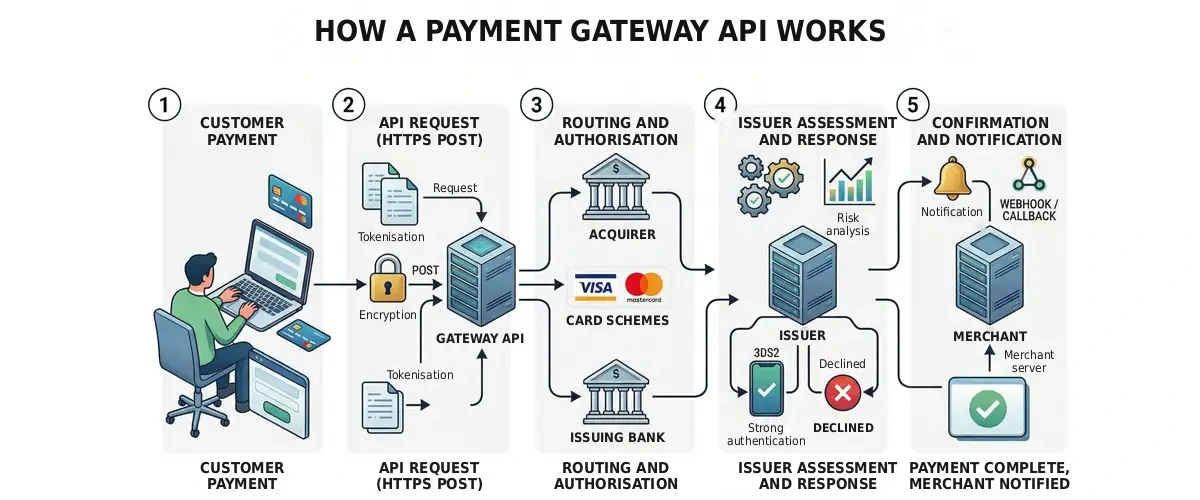
The technical flow of a RESTful payment API follows these steps:
- The buyer enters their payment details at the merchant's checkout.
- The API encrypts and sends an HTTPS POST request to the gateway server with the transaction data (amount, currency, reference, and tokenized card data).
- The gateway routes the operation to the acquirer, which transmits it to the card scheme (Visa, Mastercard) and the issuer for authorization.
- The issuer evaluates risk, applies Strong Customer Authentication (SCA) via 3D Secure 2 when applicable, and returns a response.
- The API receives the confirmation or rejection and notifies the merchant in real-time via callback or webhook.
Beyond processing payments, a payment gateway API manages refunds, cancellations, recurring billing, pre-authorizations, and status inquiries.
An in-site integration via API reduces cart abandonment by up to 20% compared to redirections to external banking pages, according to industry operational data.
Regulatory impact and applicable security of payment gateway APIs
Every payment gateway API handling card data must comply with the PCI DSS v4.0 standard, which establishes 12 security requirements (technical and operational) to protect cardholder data. The most effective strategy to reduce PCI DSS scope is tokenization: replacing the Primary Account Number (PAN) with a token that is useless outside the system.
In Europe, the PSD2 Directive and EBA RTS mandate SCA for most electronic payments. The API must support the 3DS2 protocol, which sends over a hundred contextual data points to the issuer to facilitate Risk-Based Authentication (RBA) and enable regulatory exemptions (low value, transaction risk analysis, or trusted beneficiaries).
If your business never touches the actual PAN and uses end-to-end tokenization, your compliance level drops to the minimum (SAQ-A), eliminating costly audits and reducing exposure in the event of a breach.
Operational advantages for E-commerce
Integrating a robust payment API directly impacts three critical business areas:
- Conversion: Native checkout without redirections, supporting multiple payment methods (cards, local payment methods, Apple Pay, Google Pay). Every additional method reduces abandoned carts.
- Security and Trust:Tokenization protects stored data for one-click payments and subscriptions. Dynamic 3DS2 applies friction only when risk justifies it, increasing issuer approval rates.
- Treasury and Operations: Automated refund management, real-time reconciliation, and smart retries for temporary rejections (soft declines).
Choosing a payment gateway API is not just a technical decision; it is a business decision that affects conversion, security, and compliance. Our processing infrastructure, backed by regulated premium acquiring, integrates tokenization, dynamic 3DS2, and PCI DSS compliance so that the merchant never handles sensitive data and every transaction is resolved with the highest approval rate.
Was this term useful?

Leave a Comment