Checkout
What is the Checkout process?
The checkout process is the sequence of steps a customer follows to complete a purchase in an ecommerce store. It includes reviewing the shopping cart, entering shipping details, selecting a payment method, and the final authorization of the transaction.
It is not just a simple form. It is the point where shopping experience, payment security, and the merchant's technical capability converge to convert intent into revenue. A poorly designed checkout destroys sales; a well-orchestrated one multiplies them.
How the Checkout process works in payment processing
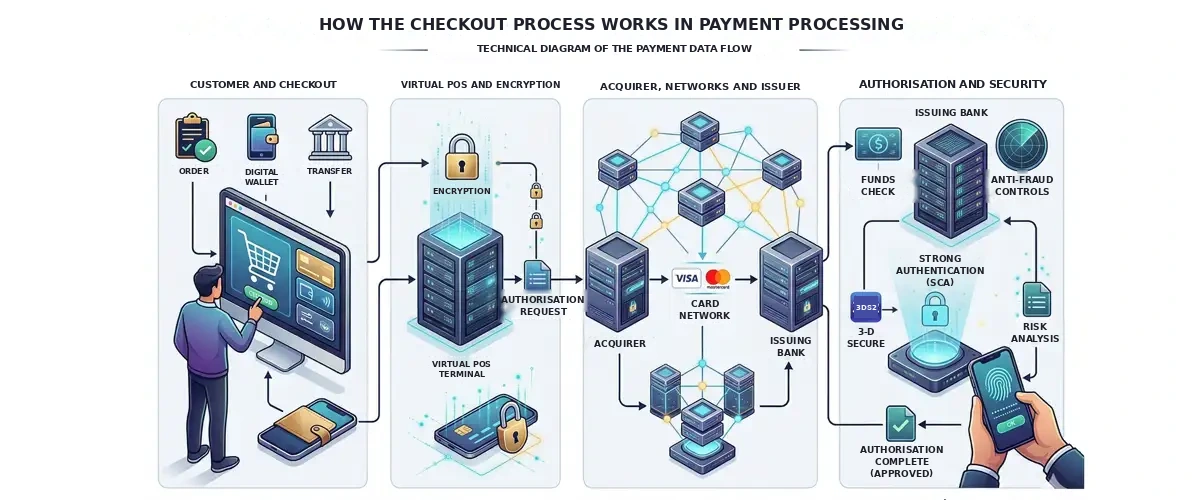
From a processing perspective, every checkout triggers a technical chain reaction in milliseconds:
- The customer confirms the cart and selects their payment method (card, digital wallet, bank transfer).
- The Virtual POS collects the data, encrypts it, and sends an authorization request to the acquirer.
- The acquirer transmits the request to the card network (Visa, Mastercard, or Amex), which redirects it to the issuing bank.
- The issuer verifies funds, applies anti-fraud controls, and, if applicable, triggers Strong Customer Authentication (SCA) via 3D Secure 2.
- The response (approval or denial) travels the reverse path back to the merchant in less than two seconds.
Regulatory impact and security in payments
Every optimized checkout must comply with a demanding regulatory framework that protects both the consumer and the merchant.
The Directive (EU) 2015/2366 (PSD2) mandates that payment service providers apply strong authentication to most electronic payments. The goal is twofold: to reduce fraud and shift liability to the issuer when the 3D Secure protocol is correctly applied.
Furthermore, any entity that processes, stores, or transmits card data must comply with PCI DSS v4.0, a standard with 12 primary requirements ranging from network segmentation to continuous access monitoring.
Tokenization complements this framework by replacing the card number (PAN) with a token that has no value out of context. This drastically reduces the merchant's PCI scope and improves the security of recurring payments.
Non-compliance with PCI DSS can lead to fines, increased fees from the acquirer, and even the termination of the payment processing contract.
Operational advantages for E-commerce
A secure payment integrated into a well-designed checkout generates direct and measurable benefits:
- Reduced cart abandonment: Fewer steps, shorter forms, and localized payment methods decrease friction at the critical moment.
- Higher conversion rate: Rich data in the authorization (consistent address, email, and phone; correct AVS/CVV) leads issuers to approve more transactions.
- Lower chargeback costs: A clear billing descriptor, visible return policies, and tokenization reduce disputes and associated costs (a chargeback can cost over €25 in penalties compared to €0.10 for a voluntary refund).
- Predictable treasury: Deferred capture allows for stock and risk verification before settlement, avoiding unnecessary refunds.
Facilitating voluntary refunds is always more profitable than forcing the customer to claim through their bank. A chargeback not only costs money but erodes the account's reputation with card schemes.
A checkout that sends complete and consistent data to the acquirer improves the trust signal to the issuer. Fields such as billing address, email, and phone number increase the approval ratio and reduce false positives in anti-fraud systems.
We design checkout flows where security and conversion do not compete. Our infrastructure, backed by regulated premium acquiring, applies tokenization, smart SCA, and optimized routing to ensure each transaction has the highest possible probability of approval.
Was this term useful?

Leave a Comment