Payment facilitator (PayFac)
What Is a PayFac or Payment Facilitator?
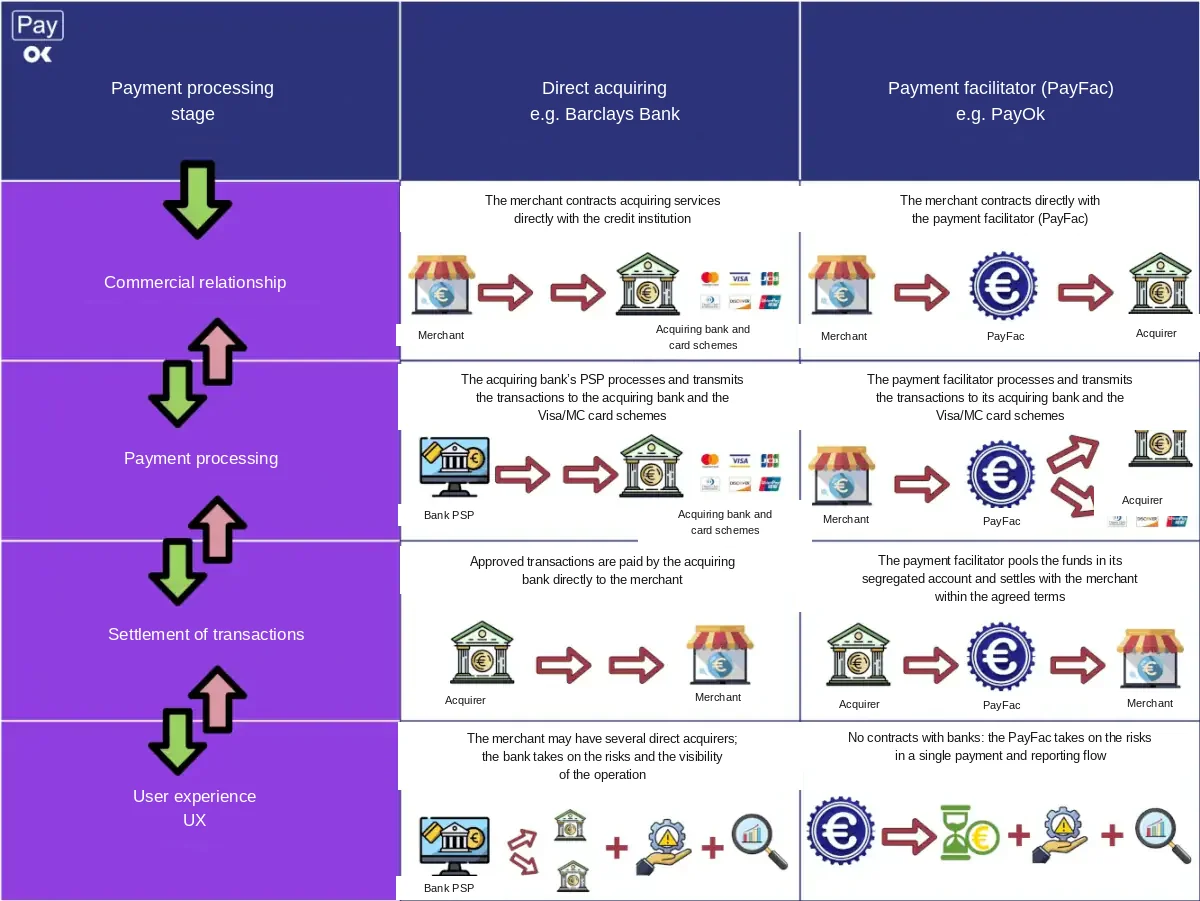
A payment facilitator (PayFac) is an entity registered with a card scheme that operates under the acquiring account of a financial institution to onboard sub‑merchants and enable them to accept electronic payments without a direct relationship with an acquiring bank.
In practice, the PayFac acts as a master merchant. It aggregates multiple businesses under a single main merchant ID (primary MID), assigns each sub‑merchant a unique MID, and manages the full lifecycle: authorization, settlement, fraud prevention, and regulatory compliance. While a traditional acquiring account may take weeks to activate, a payment facilitator can enable merchants to start accepting payments within hours.
How a PayFac works
The operational process of a PayFac follows a well‑defined chain within the four‑party card system:
- Onboarding (KYB/KYC): The facilitator verifies the business identity, ultimate beneficial owners (UBOs), economic activity, and checks sanctions lists.
- MID assignment: Each sub‑merchant receives a unique identifier under the master account, enabling individual traceability.
- Processing: The facilitator sends the authorization request to the processor, which forwards it to the card network and issuer within milliseconds.
- Settlement: The acquirer deposits funds into the PayFac’s account, and the PayFac settles the net amount to each sub‑merchant within the agreed timeframe.
- Dispute management: The facilitator centralizes the handling of chargebacks using fraud‑prevention rules and velocity checks.
The PayFac assumes responsibility before the card scheme and the acquirer for the aggregated risk of all its sub‑merchants. If a sub‑merchant generates excessive fraud or chargebacks, the facilitator—not the sub‑merchant—must answer to Visa, Mastercard, or the acquiring bank.
Regulatory impact and security requirements for a PayFac
PSD2 and Royal Decree‑Law 19/2018. The Spanish transposition of PSD2 requires any entity handling third‑party funds to hold a license or operate under an authorized institution registered with the Bank of Spain (Articles 13 and 23 of RDL 19/2018). PayFacs acting as agents must notify the supervisor of their internal AML controls before starting operations.
PCI DSS v4.0. The facilitator must comply with PCI DSS as a service provider. Annex A3 applies additional DESV validation to entities aggregating large volumes of account data. Requirement 12.9.2 mandates documenting the responsibility matrix between all parties.
AML/CFT. Law 10/2010 requires continuous monitoring, sanctions screening, and reporting suspicious activity to SEPBLAC.
| Regulation | Key obligation for the PayFac | Consequence of non‑compliance |
|---|---|---|
| PSD2 / RDL 19/2018 | License or registration as an agent with the Bank of Spain | Administrative sanctions and cessation of activity |
| PCI DSS v4.0 (Annex A3) | DESV validation and responsibility matrix (Req. 12.9.2) | Card‑scheme fines and loss of certification |
| Law 10/2010 (AML/CFT) | Monitoring, UBO identification, and reporting to SEPBLAC | Severe sanctions and criminal liability |
Operational advantages and disadvantages of a PayFac
Advantages for merchants:
- Fast activation. Onboarding time reduced from weeks to hours through centralized verification.
- Multiple payment methods. Cards, SEPA transfers, digital wallets, and Bizum through a single integration.
- Delegated risk management. The PayFac absorbs PCI DSS complexity and card‑scheme rules.
- Scalability. Ideal for marketplaces onboarding large numbers of sellers.
Disadvantages to consider:
- Higher fees. The facilitator adds a margin over the acquirer’s rate due to the risk it assumes.
- Less control. Merchants do not negotiate conditions directly with the acquiring bank.
- Dependency on the facilitator. If the PayFac loses its PCI certification or registration, all sub‑merchants are affected.
- Restrictive initial limits. Risk controls may cap volumes until the merchant builds a processing history.
Was this term useful?

Leave a Comment