Arbitration
What is arbitration in card payments when a chargeback occurs?
Arbitration in card payments is the final stage of the dispute‑resolution cycle (chargeback) in which the card network—Visa or Mastercard—acts as the ultimate judge. When a chargeback is not resolved during representment or pre‑arbitration, either party may escalate the case to the network, which issues a binding and non‑appealable decision.
Unlike financial arbitrage, which seeks profit by exploiting price differences between markets, arbitration in card payments determines who absorbs the loss of a disputed transaction: the issuer or the acquirer. The losing party must cover both the transaction amount and the arbitration fees, which typically reach around 500 USD per case.
How arbitration in card payments works
Arbitration is only triggered after all previous dispute stages have been exhausted:
- Initial chargeback. The cardholder files a claim with the issuer, which forwards the dispute to the acquirer. The merchant receives a notification with the reason code, deadlines, and evidence requirements.
- Representment. The merchant submits evidence (such as 3D Secure logs, delivery confirmation, accepted terms) to refute the chargeback.
- Pre‑arbitration. If the issuer maintains its position, it escalates the case. Visa uses its Visa Claims Resolution (VCR) system with automated decisioning. Mastercard allows a second presentment before escalation.
- Arbitration. The network reviews the full case file, applies its internal rules, and issues a final decision assigning liability and costs to the losing party.
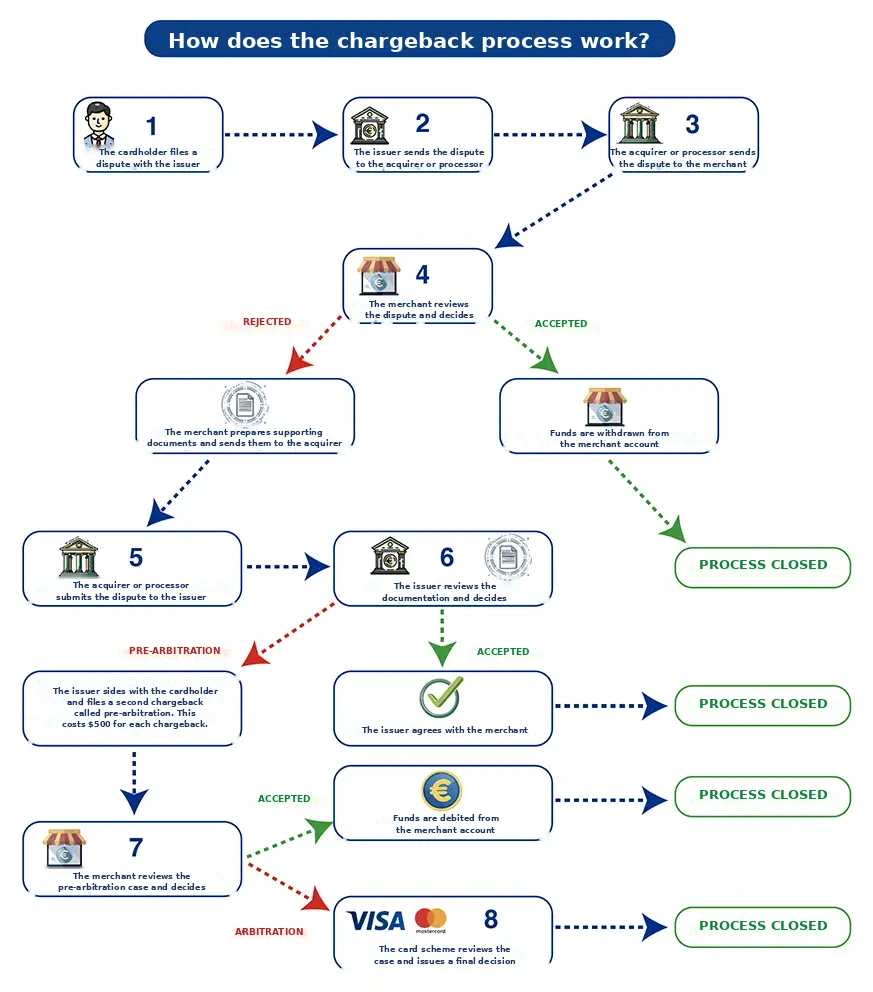
Arbitration fees in Visa and Mastercard can exceed 500 USD per case. The losing party must pay both the disputed amount and these fees. For ecommerce businesses with low average ticket value, escalating to arbitration rarely makes economic sense.
Regulatory impact and applicable security of card payment arbitration
Arbitration operates within a multilayered regulatory framework. PSD2, transposed in Spain through Royal Decree‑Law 19/2018, directly influences dispute outcomes. Article 44 requires the payment service provider to prove that the transaction was authenticated and correctly recorded. If strong customer authentication (SCA) was not applied, Article 46.2 states that the payer is only liable in cases of fraud committed by themselves.
This means that a merchant who processed the transaction with successful SCA/3D Secure has a much stronger position before the network. Without SCA in CNP (ecommerce) transactions, liability defaults to the merchant.
Article 69 of the same Royal Decree‑Law provides mechanisms for alternative dispute resolution for payment‑service users, handled by the Bank of Spain under Directive 2013/11/EU.
In parallel, Visa monitors chargeback ratios through its VAMP program, with a maximum threshold of 1%. Exceeding this threshold may result in fines, fund holds, or termination of card‑acceptance capabilities.
| Dispute stage | Merchant response time | Approximate cost | Decision maker |
|---|---|---|---|
| Initial chargeback | 30 days (Visa) / 45 days (Mastercard) | 15–100 USD | Issuer |
| Pre‑arbitration | 10 days | Variable fees | Issuer + network |
| Arbitration | Varies by network | 500 USD or more | Network (final decision) |
Advantages and disadvantages of arbitration in card payments
Arbitration provides a formal path when the merchant has strong evidence and the transaction amount justifies the cost. It allows recovery of legitimate sales, and the network’s decision sets a precedent for similar future disputes.
However, the merchant’s success rate is low because the ecosystem prioritizes cardholder protection. The combined cost (disputed amount, acquirer fees, arbitration fees) can exceed the value of the original transaction.
The most profitable strategy is prevention: implementing SCA with exemptions, maintaining strong delivery evidence, and offering proactive refunds when cost‑benefit analysis suggests it. A timely refund costs less than a chargeback and prevents escalation to stages where the merchant has less control and higher financial exposure.
Was this term useful?

Leave a Comment