Payment processor
What Is a Card Payment Processor?
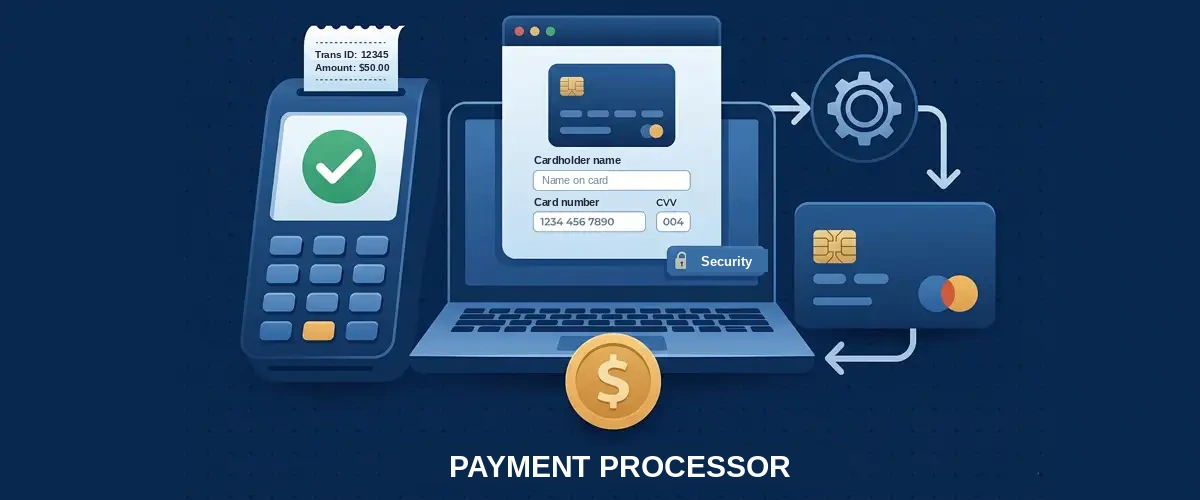
A payment processor is the technology entity that authorizes, routes, and settles electronic transactions between the merchant, the acquiring bank, and the issuing bank of the customer’s card. It operates in milliseconds and determines whether a purchase is approved or declined.
It is not a payment gateway or an acquirer, although many providers combine all three functions. The gateway captures and encrypts the data. The acquirer maintains the contractual relationship with the merchant. The processor executes the full flow: it receives the request, sends it to the card network, retrieves the issuer’s response, and returns it to the point of sale or checkout.
According to PCI DSS v4.0, any payment processor acting as an external service provider must demonstrate compliance with applicable requirements and provide verifiable evidence of its compliance status to its clients.
How a Payment Processor Works
Payment processing follows a five‑phase flow that occurs in under two seconds:
- Initiation. The customer presents their card (physical or virtual) or enters the details at checkout. The information is encrypted and sent to the processor.
- Routing. The processor identifies the corresponding card network and sends the authorization request to the issuing bank through it.
- Issuer decision. The issuing bank evaluates available funds, spending limits, fraud history, and—when applicable—the Strong Customer Authentication (SCA) required under PSD2.
- Response. The issuer returns an approval or decline code, which travels back through the same path to the merchant.
- Settlement. At the end of the day, the processor groups approved transactions into a batch and coordinates the transfer of funds from the issuer to the acquiring bank. The deposit into the merchant’s account typically occurs within one to three business days.
The quality of processing directly affects approval rates. Sending incomplete data, failing to apply tokenization, or retrying payments too aggressively increases issuer declines.
Regulatory impact and security of payment processors
In Europe, a payment processor operates under a demanding regulatory framework.
PCI DSS v4.0 defines 12 core security requirements for any entity that stores, processes, or transmits card data. Requirement 3 mandates protecting stored account data through strong encryption. Requirement 8 requires identifying and authenticating access to system components. Tokenization reduces compliance scope but does not eliminate audit obligations.
PSD2 and SCA. Directive (EU) 2015/2366, transposed in Spain through Royal Decree‑Law 19/2018, requires Strong Customer Authentication for electronic payments. EBA’s RTS define applicable exemptions: low‑value payments, Transaction Risk Analysis (TRA), and trusted beneficiaries. A processor that orchestrates these exemptions effectively improves conversion without compromising security.
| Regulatory framework | Scope | Operational impact for merchants |
|---|---|---|
| PCI DSS v4.0 | Card data protection | Obligation to validate own compliance and that of service providers |
| PSD2 / SCA | Strong authentication for payments | Checkout friction if exemptions are not properly managed |
| Royal Decree‑Law 19/2018 | Spanish transposition of PSD2 | Liability limited to €50 in case of unauthorized use |
| EBA Fraud Guidelines | Statistical fraud reporting | Mandatory semi‑annual reporting to competent authorities |
Operational pros and cons of payment processors
Choosing the right processor has direct consequences on profitability.
Advantages:
- Higher approval rates. Sending complete data (address, CVV, postal code) and applying tokenization increases issuer trust and reduces declines.
- Fraud reduction. Well‑orchestrated 3D Secure, velocity checks, and blocklists measurably reduce chargebacks.
- Centralized compliance. A PCI DSS‑certified processor absorbs part of the merchant’s regulatory burden.
Disadvantages:
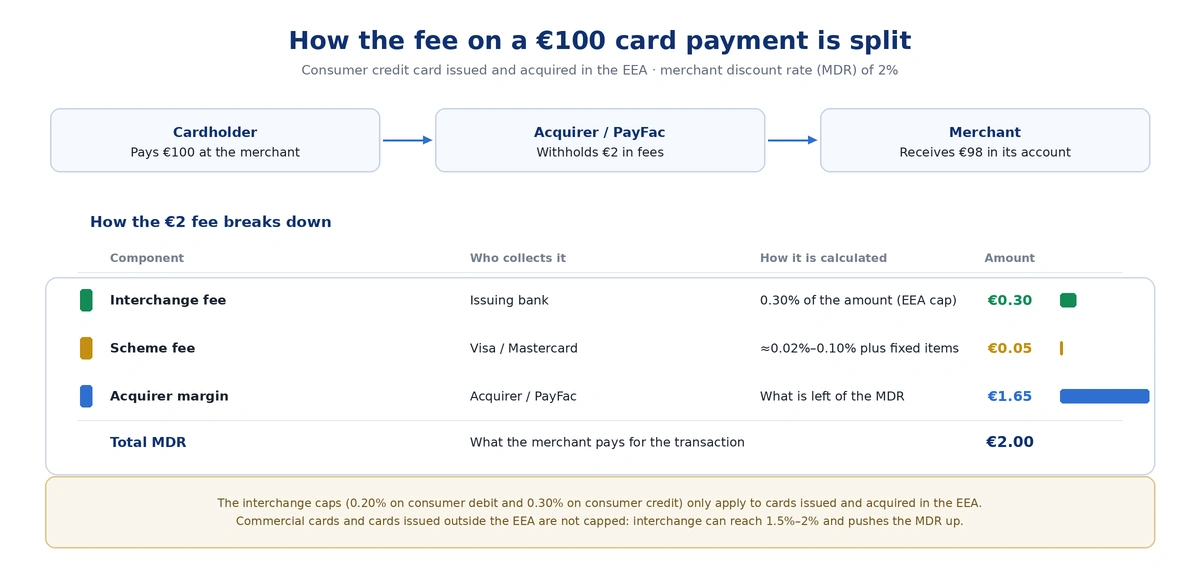
- Per‑transaction cost. Fees include interchange, scheme fees, and the processor’s margin. In opaque pricing models, hidden costs erode profitability.
- Technology dependency. If the processor experiences downtime, sales stop. Alternative routing or multi‑acquiring mitigates this risk.
- Regulatory complexity. Operating in Europe requires compliance with PCI DSS, PSD2, and local regulations, limiting options compared to less regulated markets.
Was this term useful?

Leave a Comment