ARN
What is the ARN in payments and how is it identified?
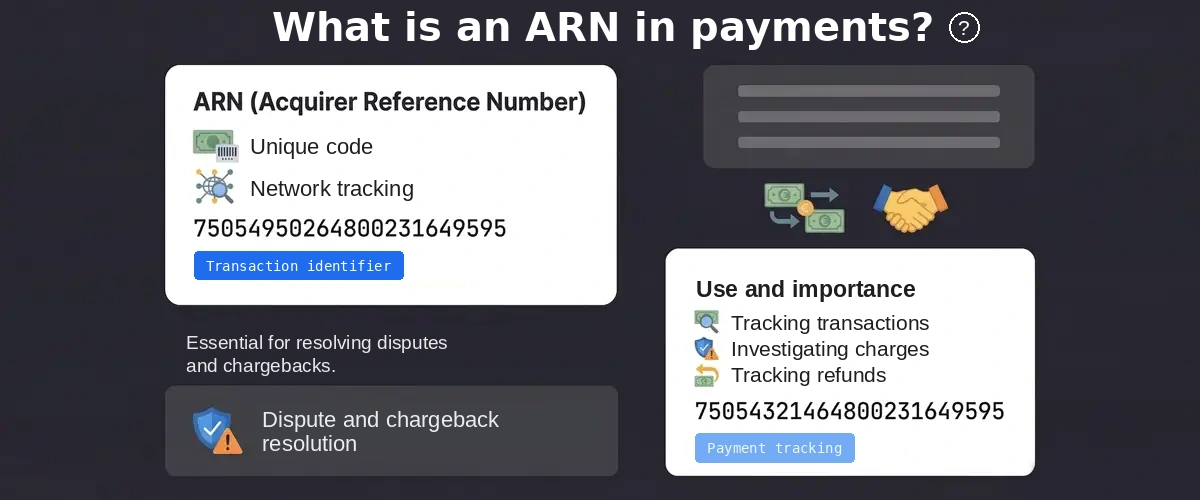
The ARN (Acquirer Reference Number) is a unique alphanumeric code assigned by the acquiring bank to every credit or debit card transaction. It acts as the traceability identifier that accompanies the payment throughout its entire journey: from the merchant, through the card network (Visa, Mastercard, JCB, Diners), to the cardholder’s issuing bank.
In the daily operations of an ecommerce business, the ARN is the tool that allows merchants to locate a refund in transit, provide evidence in a chargeback process, and resolve customer‑service incidents without relying solely on the issuer’s response.
How the ARN works
The ARN is generated when the acquiring bank processes the transaction and sends it to the card network. Its lifecycle follows this flow:
- The cardholder makes a payment at the merchant (physical or online).
- The payment processor sends the authorization request to the card scheme.
- The acquiring bank generates the ARN and links it to the settled transaction.
- The ARN travels with the funds through the network to the issuing bank.
- Each party involved (acquirer, scheme, issuer) can consult the ARN to verify the status of the payment or refund.
In practice, the ARN is especially useful in two scenarios. The first is refund tracking: when a customer claims they have not received a refund, the merchant can provide the ARN so the issuer can locate the funds in its system. The second is dispute and chargeback management, where the ARN acts as documentary evidence linking the original transaction to the disputed charge.
The ARN takes between 48 and 72 hours to be generated after the transaction is settled. If a refund is processed as a reversal (before settlement), no ARN is generated because technically there is no interbank movement to track.
Regulatory impact and applicable security of the ARN
The ARN is not a requirement invented by payment gateways. Its existence responds to regulatory obligations that require full traceability of payment operations.
PSD2 (Directive (EU) 2015/2366), transposed in Spain through Royal Decree‑Law 19/2018, establishes that payment service providers must give both payer and beneficiary a reference that uniquely identifies each operation. The ARN fulfills exactly that function within the card ecosystem.
From a security perspective, the PCI DSS v4.0 standard requires entities involved in payment processing to maintain audit logs that allow reconstruction of the full transaction sequence. The ARN is a key part of that record, as it connects the merchant’s action with the movement of funds across the network.
Additionally, within card‑scheme compliance programs such as VAMP (Visa Acquirer Monitoring Program), the ARN allows the acquirer to demonstrate traceability of disputed transactions. An acquirer unable to link a chargeback to its corresponding ARN loses defense capability and may face penalties exceeding €500 per case in arbitration.
Operational advantages and disadvantages of using the ARN in payments
| Aspect | Advantage | Limitation |
|---|---|---|
| Traceability | Allows end‑to‑end tracking of any payment or refund between acquirer and issuer | Only available for Visa, Mastercard, JCB, and Diners networks; not applicable to SEPA transfers or alternative methods |
| Dispute management | Provides strong documentary evidence in chargeback and pre‑arbitration processes | Not generated for reversals before settlement, which may complicate certain cases |
| Customer support | Reduces refund‑related resolution times from days to minutes | The end customer cannot access it directly; they depend on the merchant or acquirer |
| Ecommerce conversion | Efficient refund handling with ARN improves post‑purchase experience and reduces chargeback rates | Requires integration with the payment gateway to automate retrieval, which involves technical development |
Was this term useful?

Leave a Comment