Payment Link
What is a payment link?
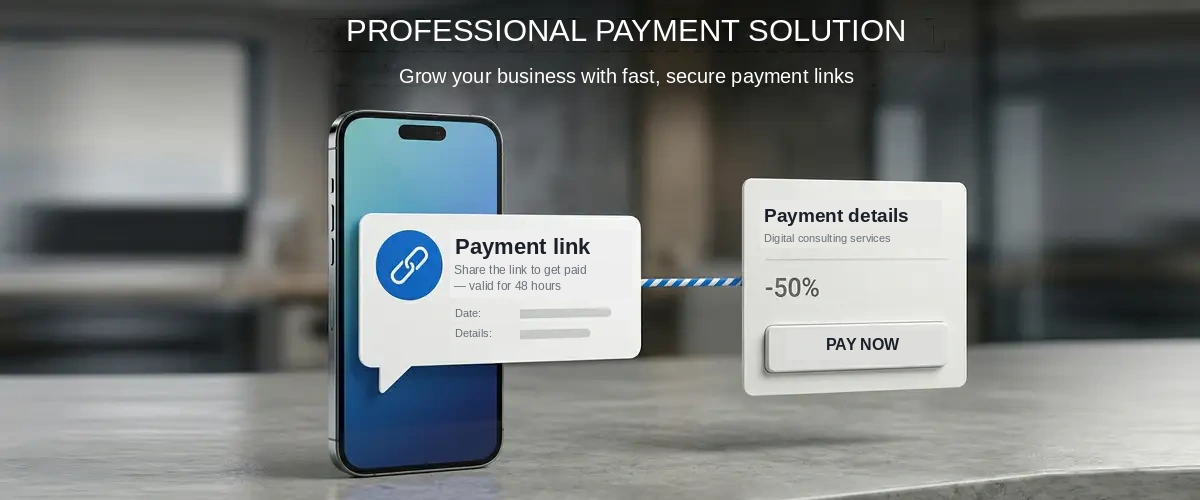
A payment link is a unique URL generated by a payment service provider that directs the customer to a secure checkout page. It allows businesses to accept card payments, digital wallets or bank transfers without needing an online store, API integration or technical development.
For merchants, a payment link removes the barrier to entering digital payments. A business without a website generates the link, sends it via WhatsApp, email or social media, and gets paid in seconds. For customers, it is a frictionless pay‑by‑link experience with no registration required.
How a payment link works
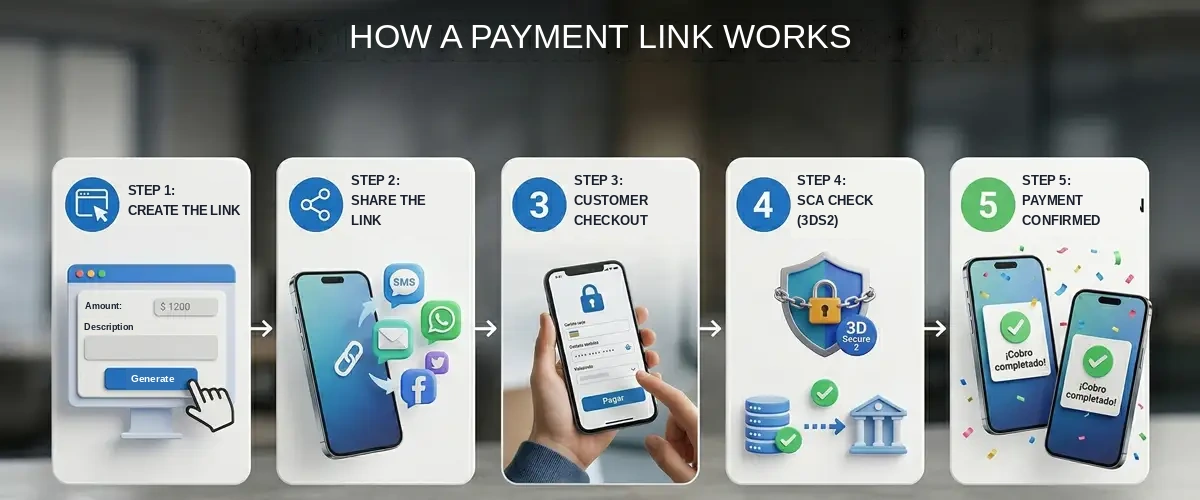
The operational flow of paying by link follows five steps:
- Generation. The merchant accesses their provider’s dashboard, enters amount, description and reference. The system creates a unique payment URL.
- Sending. The link is shared via SMS, email, WhatsApp, social media or embedded in a digital invoice.
- Checkout. The customer opens a secure, encrypted page, selects a payment method and enters their details.
- Authentication. The transaction is sent to the acquirer and issuer. If it exceeds exemption thresholds, strong customer authentication (SCA) is triggered through 3D Secure 2.
- Confirmation. Both merchant and customer receive the payment result instantly.
It is important to distinguish between a static link (open amount, reusable) and a dynamic link (unique amount and reference per transaction). Dynamic links improve reconciliation and enable more precise fraud control.
According to the Baymard Institute, 17% of online shoppers abandon their cart because the checkout is too long. Payment links directly address this drop‑off point by reducing the process to a single click.
Regulatory impact and applicable security of payment links
Every pay‑by‑link transaction is considered a remote operation under Article 3 of Royal Decree‑Law 19/2018, which transposes PSD2. This implies:
- Mandatory SCA. Article 97 of PSD2 requires strong customer authentication for remote payments. The checkout must integrate 3D Secure 2 so the issuer can authenticate the cardholder with two factors. Low‑risk (TRA) or low‑value exemptions may apply when justified.
- PCI DSS v4.0. The page where the customer enters card data must comply with the 12 core requirements of the standard: cardholder data encryption, access restriction and continuous monitoring. Merchants must ensure their provider maintains valid certification.
- Impersonation risk. A link can be manipulated through phishing. Using HTTPS, a verifiable domain and controls such as velocity checks, blocklists and fraud scoring is essential.
Operational advantages and disadvantages
| Advantages | Disadvantages |
|---|---|
| Remote payments without a website or technical integration | Limited brand customization |
| Reduced cart abandonment | No cart: one transaction per link |
| Multichannel: SMS, email, social media, invoicing | More complex refund management |
| Regulatory compliance delegated to the provider | Potentially higher fees |
| Ideal for social selling and invoice payments | Possible distrust if the customer does not recognize the URL |
A payment link does not replace a virtual POS for high‑volume businesses. Its value lies in agility for independent professionals, social‑media sales and one‑off payments where activation speed matters more than checkout customization.
Was this term useful?

Leave a Comment