Rolling reserve
What Is a Rolling Reserve?
Rolling reserve is the temporary withholding of a percentage of card‑processed sales that the acquiring bank applies to a merchant as a security deposit. Its purpose is to cover potential chargebacks, fraud, or disputes that may arise weeks or even months after the original transaction.
In practice, it works as a financial buffer. The acquirer withholds between 5% and 15% of the monthly gross processing volume for an agreed period, typically between 90 and 180 days. Once that period ends, the funds are released progressively following a FIFO model (first in, first out).
This mechanism is especially common among merchants classified as high‑risk by card schemes (Visa and Mastercard), but it is also applied to new businesses with no processing history or those with elevated chargeback ratios.

How Rolling reserve works
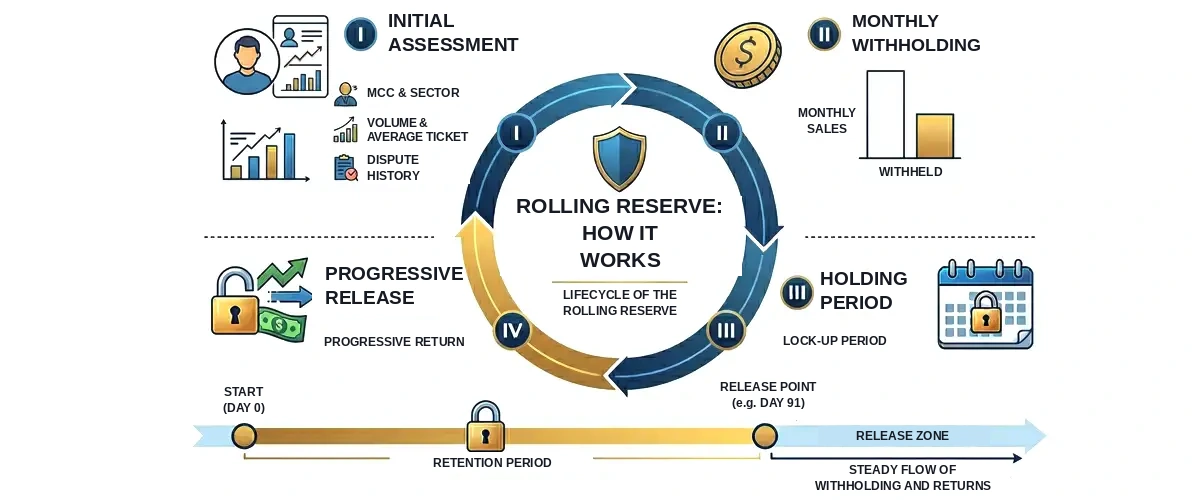
The lifecycle of a rolling reserve follows a clear sequence:
- Initial risk assessment. During merchant onboarding, the acquirer analyzes the business category (MCC), estimated volume, average ticket size, and dispute history. Based on this, it determines whether a reserve is necessary and under what conditions.
- Withholding on each settlement. If a merchant processes €10,000 per day and the reserve is 10%, the acquirer withholds €1,000 daily in a separate account. The merchant receives the remaining €9,000 in its usual settlement.
- Holding period. Funds remain withheld for the agreed period. This timeframe is calibrated to cover the cardholder dispute window, which can reach up to 120 days from the purchase date.
- Progressive release. Starting on day 91 (for a 90‑day reserve), the amounts withheld on day one are released. The next day, the amounts from day two are released, and so on. Once the cycle stabilizes, the merchant receives daily releases equivalent to its daily withholdings, unless chargebacks have been deducted from those funds.
Visa, through its VAMP(Visa Acquirer Monitoring Program), penalizes acquirers whose merchants exceed a dispute ratio of 0.9% of sales. A high rolling reserve is the acquirer’s first defensive measure to avoid fines and potential revocation of its processing license.
Regulatory impact and applicable security for Rolling Reserves
Rolling reserves are not explicitly regulated by a single law, but they fall under several legal obligations that apply to payment service providers in Europe.
Royal Decree‑Law 19/2018, which transposes PSD2 into Spanish law, states in Article 21 that payment institutions must safeguard user funds. Funds withheld as rolling reserves must be deposited in a segregated safeguarding account at a credit institution or invested in safe, liquid assets. In the event of the acquirer’s insolvency, users have an absolute right of separation over those funds.
From an AML perspective, the EBA Guidelines EBA/GL/2023/04 on AML/CFT risk factors consider rolling reserves a mitigation tool that allows maintaining a commercial relationship with a high‑risk client without immediately closing the account. In other words, before terminating a relationship, regulators expect acquirers to apply intermediate measures such as security reserves.
| Type of reserve | Mechanism | Release |
|---|---|---|
| Rolling reserve | Daily percentage withheld for a fixed period | Progressive (FIFO) after the holding period |
| Fixed reserve (capped) | Withheld until a maximum amount is reached | At account closure or renegotiation |
| Up‑front deposit | One‑time advance payment of a lump sum | At contract termination |
Advantages and disadvantages of Rolling Reserves
Rolling reserves create a balance between ecosystem security and merchant liquidity.
Advantages:
- Allows high‑risk merchants to operate with card payments when they would otherwise be denied an acquiring account.
- Protects the acquirer and card schemes from losses due to mass chargebacks or merchant insolvency.
- Negotiable terms. A clean dispute history over 6–12 months can justify reducing the reserve percentage or removing it entirely.
Disadvantages:
- Reduces available cash flow. An ecommerce business with an 8% net margin facing a 10% reserve may experience liquidity stress from the first month.
- Does not generate interest for the merchant. Withheld funds sit in a non‑interest‑bearing account.
- May be applied unilaterally if the acquirer detects an increase in chargeback ratios, often without prior notice depending on the contract.
The operational key for any digital merchant is to negotiate conditions before signing: reserve percentage, holding period duration, existence of a maximum cap, and the objective criteria for reducing or removing the reserve.
Was this term useful?

Leave a Comment