Chip EMV
What is the EMV chip on the magnetic stripe?
The EMV chip is a microprocessor embedded in credit and debit cards that generates a unique dynamic cryptogram for every transaction. Its name comes from Europay, Mastercard and Visa, the companies that created the standard in 1994. Unlike the magnetic stripe, which stores static data vulnerable to cloning, the chip turns each payment into an unrepeatable cryptographic event.
The standard is managed by EMVCo, an organization owned by American Express, Discover, JCB, Mastercard, UnionPay and Visa. By the end of 2024, more than 14.7 billion EMV‑chip cards were in circulation and over 96% of card‑present transactions used this technology.

How the EMV chip works
When a chip card is inserted or tapped on a payment terminal, the following process occurs in milliseconds:
- Card authentication: the terminal validates the card using Dynamic Data Authentication (DDA) or Combined Data Authentication (CDA), based on public‑key cryptography.
- Cryptogram generation: the chip produces an ARQC code linked to the amount, date and transaction counter. It is single‑use.
- Cardholder verification: the terminal requests PIN, signature or no verification. In Europe, the dominant model is chip and PIN.
- Authorization: the acquirer sends the cryptogram to the issuer, which validates it and returns an ARPC to complete the transaction.
In contactless (NFC) payments, the cryptographic process is identical, but communication occurs via proximity. The image below shows an example of an offline EMV transaction on a ship.
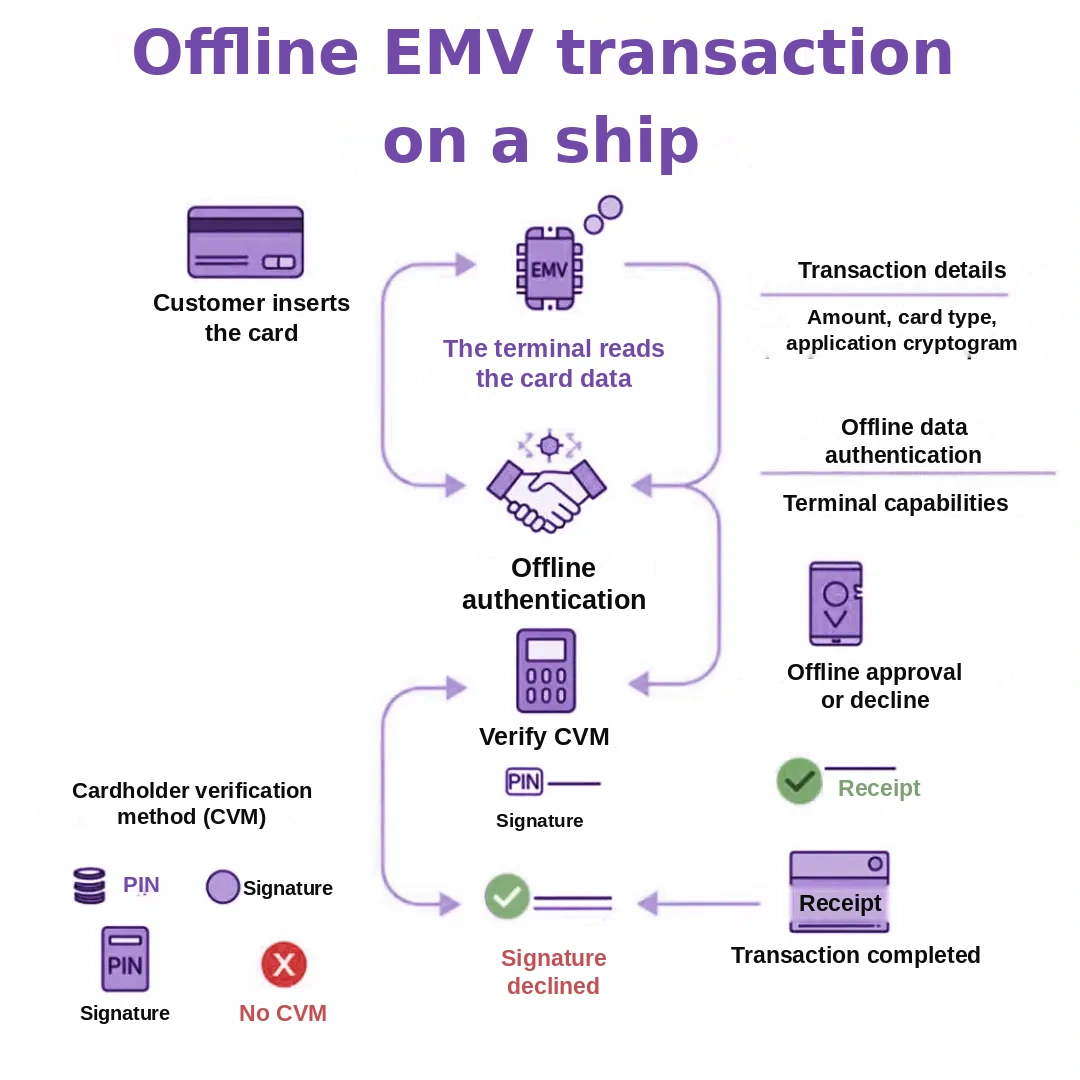
Dynamic Data Authentication (DDA) was the real leap in EMV security. Unlike static authentication (SDA), DDA generates a different cryptographic signature for every transaction, making modern chip cloning practically impossible.
Regulatory impact and applicable security for the EMV chip
In the European Economic Area, three frameworks directly govern EMV chip usage:
| Regulatory framework | Key requirement | Consequence of non‑compliance |
|---|---|---|
| PCI DSS v4.0 | Protection of POI devices against tampering | Fines, higher fees or contract termination |
| PSD2 / RDL 19/2018 | SCA for electronic payments (chip + PIN = two factors) | Issuer declines and liability shifted to the merchant |
| Visa/Mastercard rules | Liability shift: EMV acceptance is mandatory | Merchant assumes counterfeit‑fraud losses |
Liability is the most relevant operational lever for merchants. If a business forces magnetic‑stripe fallback when the card has a chip, it assumes full responsibility for counterfeit chargebacks.
Operational advantages and disadvantages
Advantages for merchants:
- Drastic reduction in card‑present fraud. Cloning a dynamic‑cryptogram chip is unfeasible with current technology.
- Lower exposure to chargebacks. The liability shift transfers counterfeit responsibility to the issuer.
- Simplified compliance. EMV‑certified terminals facilitate PCI DSS and PSD2 alignment.
- Global compatibility. An EMV card works on any certified terminal worldwide.
Limitations to consider:
- Does not protect online channels. Ecommerce requires 3D Secure and tokenization.
- Terminal investment. Migrating from magnetic stripe requires hardware upgrades.
- Chip insertion vs. contactless. Chip reading is slower than NFC in high‑turnover environments.
The EMV chip is the foundation for network tokenization and mobile NFC payments. Without this standard, neither Apple Pay nor Google Pay could generate the cryptograms that secure every contactless transaction.
Was this term useful?
1 of 1 I found it useful

Leave a Comment