MCC
What is the MCC activity code?
The MCC code (Merchant Category Code) is a three‑ or four‑digit number that classifies the main activity of a business within the card‑payments ecosystem. It is assigned by the acquiring bank when the merchant account is created and travels with every processed transaction.
This code, standardized under ISO 18245, is the first label Visa, Mastercard, and other card schemes read to determine how much it costs to process a transaction, what level of risk it carries, and which security rules apply.
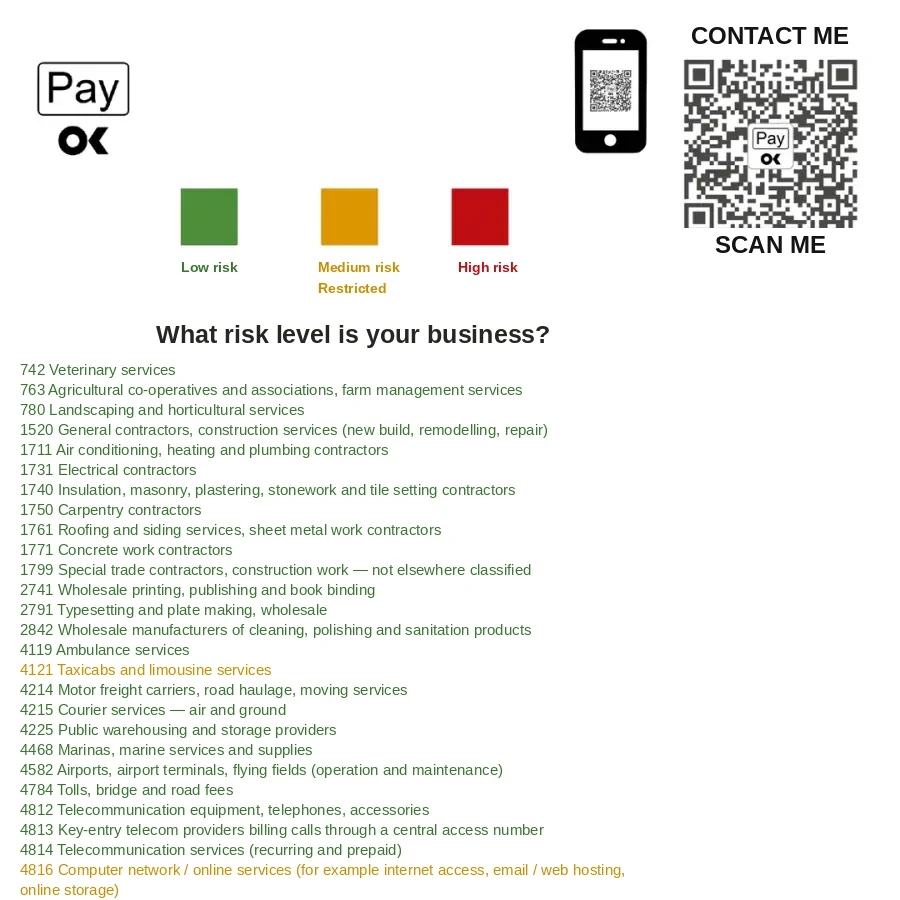
How the MCC code works
The MCC plays a role in every stage of a card transaction’s lifecycle:
- Initial assignment. When a merchant signs the payment acceptance contract, the acquirer evaluates the real activity (not just the declared one) and assigns an MCC. A restaurant receives 5812, a grocery store 5411, and an airline 4511.
- Authorization. The MCC is sent to the issuing bank along with the amount. The issuer uses this data to apply cardholder spending controls and decide whether to approve or decline the transaction.
- Settlement and fees. Card schemes apply the interchange fee corresponding to the MCC. Low‑risk categories (such as supermarkets) pay lower fees than sectors considered high‑risk (such as travel or online gambling).
- Fraud detection. If a cardholder’s purchase pattern does not match the merchant’s MCC category, fraud‑prevention systems generate automatic alerts.
An incorrect MCC can double the fees a merchant pays and reduce approval rates. Auditing this code is the first step in any acquiring‑cost optimization.
Regulatory impact and applicable security of the MCC code
The MCC is not just an operational label. It has direct regulatory consequences in the European and Spanish markets.
Regulation (EU) 2015/751 on interchange fees sets caps of 0.2% for debit cards and 0.3% for consumer credit cards within the European Economic Area. But these limits apply depending on the merchant category. Corporate cards and interregional transactions fall outside the cap, and in those cases the MCC directly determines the real cost, which can exceed 1.5%.
Royal Decree‑Law 19/2018, which transposes PSD2 in Spain, reinforces the obligation for payment service providers to categorize merchants correctly. An incorrect MCC may lead to non‑compliance with reporting obligations to the Bank of Spain.
Additionally, card‑scheme monitoring programs (such as Visa’s VAMP) use the MCC as the first risk filter. A merchant with a high‑risk MCC (for example, 7995 for gambling or 6051 for cryptoassets) enters a stricter supervision regime with enhanced AML/CFT requirements.
| MCC | Sector | Risk level | Impact on fees |
|---|---|---|---|
| 5411 | Supermarkets | Low | Minimum interchange fees |
| 5812 | Restaurants | Low | Standard regulated fees |
| 4511 | Airlines | Medium | Higher fees due to high ticket value |
| 7995 | Online gambling | High | Uncapped fees, mandatory reserves |
| 6051 | Cryptoassets | High | Maximum fees, enhanced KYC |
Operational advantages and disadvantages of the MCC
Understanding and managing the MCC of an ecommerce business has a direct impact on profitability.
Advantages:
- Cost optimization. A correct MCC ensures the merchant pays the appropriate interchange fee without overcharges.
- Higher approval rates. Issuers trust transactions whose MCC aligns with the cardholder’s purchase pattern, improving conversion.
- Access to SCA exemptions. Certain MCCs make it easier to apply strong‑authentication exemptions under PSD2, reducing checkout friction.
Disadvantages:
- Rigid assignment. A merchant with multiple business lines can only have one MCC per terminal, forcing the choice of a predominant category.
- Costly reclassification. Changing an MCC requires a formal process with the acquirer. If the code becomes outdated, the cost impact may take months to correct.
- Impact on rewards programs. A generic MCC such as 5999 (miscellaneous stores) may prevent cardholders from receiving points or cashback.
Was this term useful?

Leave a Comment