Credit card networks
What is a credit or debit card network?
A credit card network or card scheme in English is the technological and regulatory infrastructure that connects the cardholder, issuer, acquirer and merchant in every card transaction. Visa, Mastercard, American Express, UnionPay, JCB and Discover are the main global networks.
The network does not issue cards or grant credit (except Amex). Its role is to define the rules, route authorization messages and ensure settlement of funds. When a customer taps their card on a POS terminal or enters their details in an ecommerce checkout, the network transports that request from the merchant’s bank to the cardholder’s bank and returns the response in under three seconds.
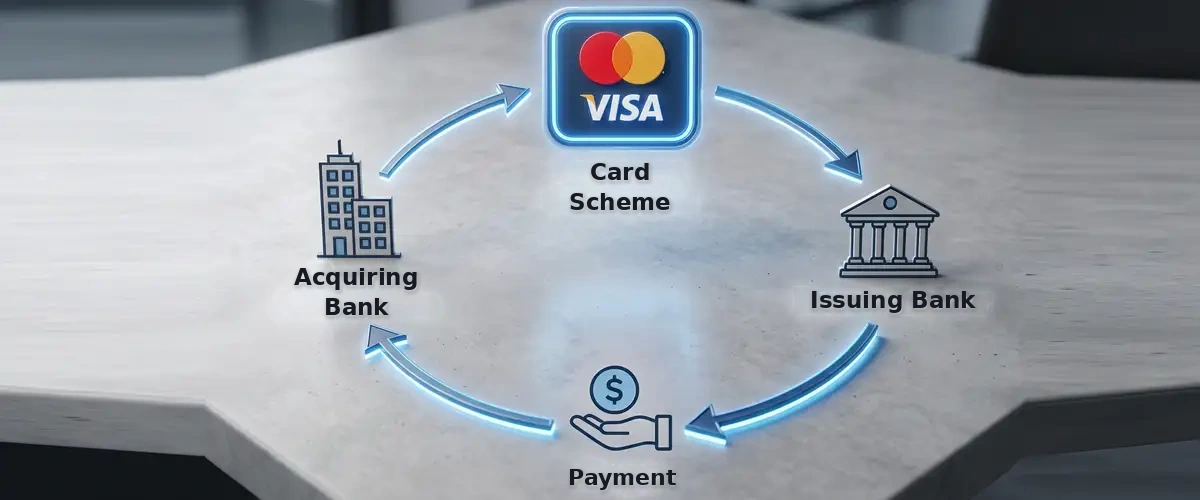
How a credit card network works
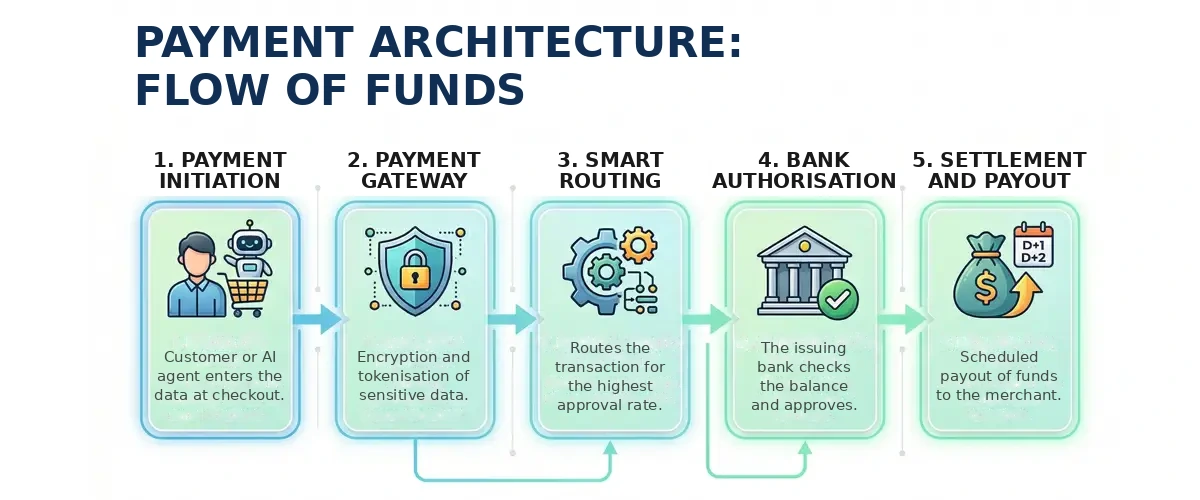
The process follows the four‑party model, which supports more than 90% of global card payments:
- Payment initiation. The cardholder presents the card. The terminal captures encrypted data via EMV chip.
- Sending to the acquirer. The gateway transmits the request to the merchant’s acquiring bank.
- Routing through the network. The scheme identifies the card’s BIN and forwards the request to the issuing bank.
- Issuer decision. The cardholder’s bank checks balance, limits and fraud rules. It returns an approval or decline.
- Clearing and settlement. At end of day, the network manages the net transfer of funds between issuer, acquirer and merchant.
In Europe, interchange fees are capped at 0.2% for debit and 0.3% for consumer credit cards under Regulation (EU) 2015/751, making the European market one of the most competitive globally in acceptance costs. There is an alternative model, the three‑party scheme, where the network also acts as issuer (as in American Express), typically resulting in higher merchant fees.
Regulatory impact and security requirements for card schemes
Card networks operate under a strict regulatory framework in the EU:
- PSD2 (Directive (EU) 2015/2366). Requires strong customer authentication (SCA) for electronic payments. The technical protocol is 3D Secure 2, validated through the network.
- Regulation (EU) 2015/751. Sets interchange caps for consumer cards in the EEA. Corporate cards and inter‑regional transactions may exceed 1.5%.
- PCI DSS v4.0. Requires encryption, network segmentation and access controls across all actors in the payment chain.
- Royal Decree‑Law 19/2018. Transposes PSD2 into Spanish law.
An ecommerce that does not properly support 3D Secure will face more declines, assume fraud liability and incur scheme penalties.
Operational advantages and disadvantages
| Advantages | Disadvantages |
|---|---|
| Global reach with a single integration (over 200 countries) | Cumulative costs: interchange + scheme fees + acquirer margin |
| Regulated fees in Europe compared to markets without caps like the U.S. | Approval rates depend heavily on the issuer |
| Standardized security: tokenization, EMV and SCA | Increasing regulatory complexity (SCA exemptions, fee updates) |
| Settlement timelines defined by the scheme | For low‑value tickets (under 10 €), fixed fees erode margins |
Was this term useful?

Leave a Comment