Wire or bank transfer
What is a fast and secure wire transfer?
A wire transfer is an electronic operation through which a payer sends funds from their payment account to the account of a beneficiary. In Europe, it operates under the SEPA (Single Euro Payments Area) scheme, which standardizes euro payments across 36 countries with common rules for format, timelines, and user rights.
Unlike an internal transfer (between accounts of the same holder within the same institution), a bank transfer involves at least two payment service providers and a clearing and settlement mechanism (CSM) that reconciles orders between institutions.
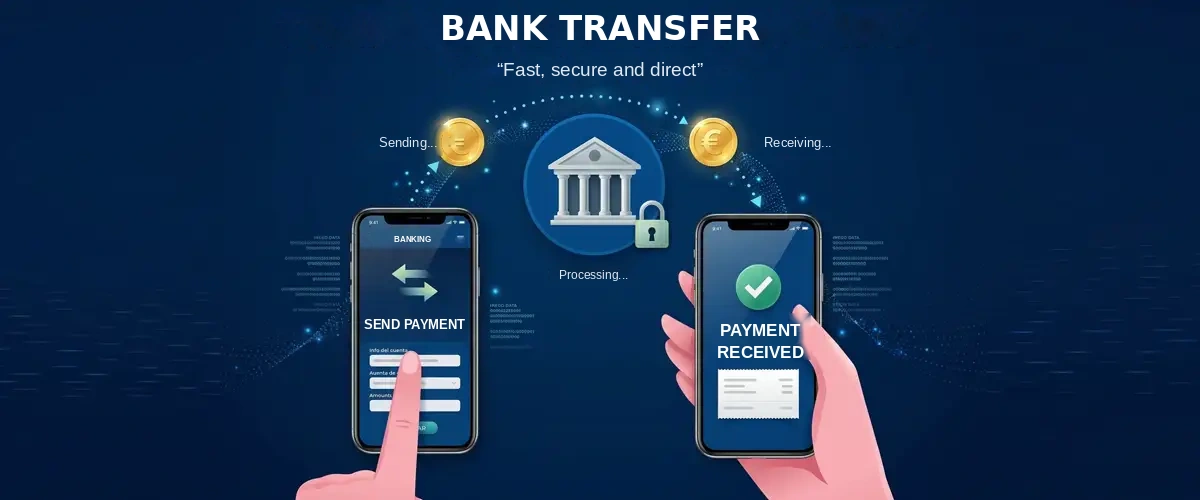
How a wire transfer works
The operational flow follows a standardized process:
- Initiation. The payer authorizes the transfer via online banking, mobile app, or branch, providing the beneficiary’s IBAN and the amount.
- Verification. The issuing bank verifies the payer’s identity through strong customer authentication (SCA) and checks available funds.
- Clearing. The order is sent to the corresponding CSM. In Spain, Iberpay manages both standard and instant transfers.
- Settlement. The receiving bank credits the funds to the beneficiary’s account. For a standard SEPA transfer, the maximum timeframe is 1 business day. For an instant transfer (SCT Inst), the credit is completed in under 10 seconds, 24/7/365.
| Feature | Standard SEPA | SCT Inst (instant) | SWIFT |
|---|---|---|---|
| Settlement time | 1 business day | Under 10 seconds | 1–5 business days |
| Availability | Business days | 24/7/365 | Business days |
| Geographic scope | 36 SEPA countries | 36 SEPA countries | Global |
| Maximum fee | Variable by institution | Cannot exceed the standard fee (Regulation EU 2024/886) | Variable, includes correspondent banks |
| Irrevocability | High after execution | Practically total | High after execution |
Regulation (EU) 2024/886 requires all institutions offering standard euro transfers to also offer instant transfers, and the fee for instant transfers cannot exceed the equivalent standard fee. In Spain, institutions such as BBVA have already matched or removed the additional cost in digital channels.
Regulatory impact and applicable security in wire transfers
Wire transfers in the EU are regulated by a robust framework that protects both the payer and the beneficiary.
Directive (EU) 2015/2366 (PSD2), transposed in Spain through Royal Decree‑Law 19/2018, requires strong customer authentication (SCA) to initiate any electronic payment. This means verifying at least two independent factors: something the user knows (password), possesses (mobile phone), or is (biometrics).
Additionally, Regulation (EU) 2024/886 introduces beneficiary verification (IBAN Name Check): before executing the transfer, the institution must confirm free of charge whether the beneficiary’s name matches the IBAN. This control significantly reduces impersonation fraud and fake invoices.
Regarding anti‑money laundering (AML/CFT), Law 10/2010 and EBA Guidelines EBA/GL/2023/04 require institutions to apply due diligence, monitor suspicious activity, and report to SEPBLAC when necessary.
For e-commerce, integrating bank transfers as a payment method requires complying with KYC/KYB and maintaining full traceability of each operation.
Operational advantages and disadvantages
Advantages for ecommerce:
- No chargeback risk. Transfers are “push” payments initiated by the payer, eliminating the chargeback disputes common in card payments.
- Lower transaction cost. Fees are usually lower than interchange and acquiring fees, especially for high‑value payments.
- Immediate liquidity with SCT Inst. Merchants receive funds in seconds, improving cash flow.
- Universal access. Any account holder in the SEPA area can pay without needing a card.
Disadvantages to consider:
- More friction at checkout. The customer must authorize the payment in their online banking, which may affect conversion rates.
- Irrevocability. If the payer enters the wrong IBAN, recovery depends on the receiving bank’s cooperation.
- SCT Inst coverage still expanding. Although Regulation 2024/886 broadens mandatory adoption, some institutions are still adapting. A fallback to standard transfer is necessary.
- More complex reconciliation. Without properly configured unique references, matching payments to orders requires strong automation.
Was this term useful?

Leave a Comment