De-risking
- What is financial De-risking?
- Causes: Why do entities resort to De-risking?
- Operational mechanism: How is the process executed?
- Regulatory Framework and Supervisory Stance
- Systemic consequences and business impact
- De-risking Assessment: Positive and negative implications
- Mitigation strategies and best practices
- Sources and recommended reading
What is financial De-risking?
De-risking (or wholesale risk avoidance) is a phenomenon in the financial sector where banking institutions, correspondent banks, and payment gateways choose to terminate or restrict business relationships with entire categories of clients instead of actively managing the individual risks associated with them.
Unlike traditional risk management, which evaluates the profile of each business on a case-by-case basis, de-risking applies a mass exclusion policy by sector or geography. In global practice, this process leaves legitimate industries and businesses locked out of the formal financial system due to the tightening and pressure of Compliance regulations.
Causes: Why do entities resort to De-risking?
Financial institutions execute these generic exclusions driven by factors that go beyond individual client risk:
- Fear of sanctions and multi-million dollar fines: Dread of regulatory punishment or high remediation costs arising from supervisory failures.
- Low profitability relative to compliance costs: Calculating the cost of required Enhanced Due Diligence (EDD) often exceeds the commercial margin generated by the client.
- Reputational risk: Fear of being publicly associated with sectors or jurisdictions deemed "high risk."
- Protection of correspondent banking networks: Entities need to maintain a "clean" risk profile and image to ensure international banks continue processing their cross-border transactions.
- Deficient application of the Risk-Based Approach (RBA): Difficulty or operational unwillingness to manage risk proportionally, opting instead for outright elimination.
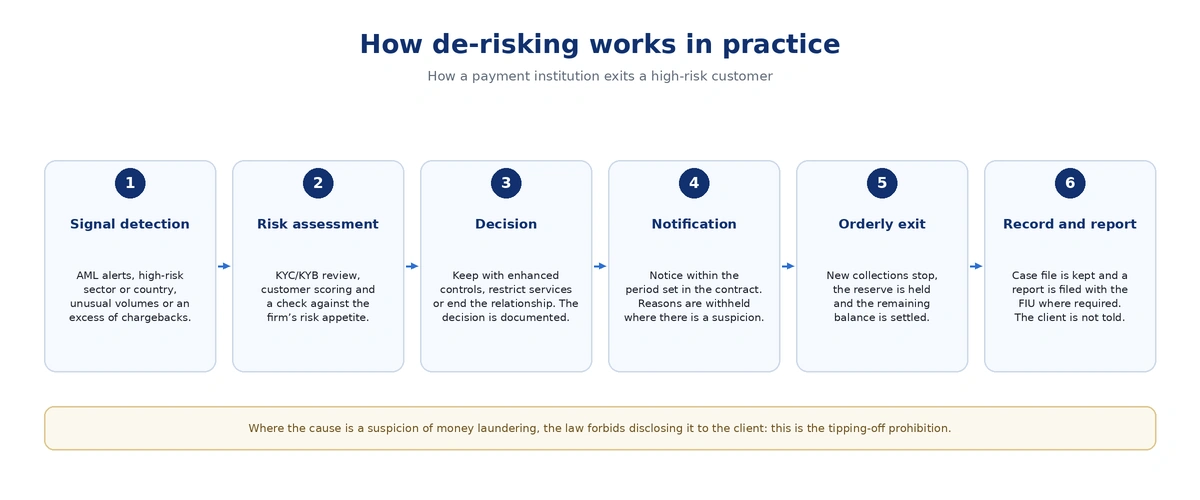
Operational mechanism: How is the process executed?
When a business operates in a sector perceived as complex (e.g., crypto assets, online gambling, remittances, neobanks, or NGOs), the process typically unfolds in the following phases:
- Sectoral classification: The institution classifies the client's entire category as problematic during the application stage or routine account review (KYB).
- Cost vs. risk evaluation: Ongoing monitoring and audit requirements are estimated to outweigh the commercial benefit.
- Decision and service blocking: The institution executes mass cancellations or rejections by category rather than conducting an individualized analysis.
- Termination of services: The company suddenly loses its collection and payment infrastructure, often without a personalized justification or viable alternatives.
Regulatory Framework and Supervisory Stance
Legal pressure stems from a strict cross-border ecosystem against Anti-Money Laundering and Countering the Financing of Terrorism (AML/CFT), backed by EU Directives (AMLD / AMLR), EBA guidelines, and local supervisors such as SEPBLAC in Spain.
However, international regulatory bodies such as the FATF/GAFI, the EBA, and SEPBLAC itself have expressed concern, reminding institutions that wholesale de-risking goes against the spirit of regulation:
- Incompatibility with the Risk-Based Approach: Regulations (such as Law 10/2010 or Art. 21.3 of the AMLR / EU Directive 2024/1624) require institutions to analyze each case individually and document the actual impossibility of applying due diligence before proceeding with a rejection.
- Threat to transparency: By excluding legitimate businesses, institutions push them toward informal or unregulated payment channels, making it harder to track financial crime.
📌 FATF / GAFI Warning:De-risking is not a proper compliance strategy. Wholesale financial exclusion does not eliminate global risk; rather, it shifts it into opaque channels, weakening the overall transparency of the financial system.
Systemic consequences and business impact
The consequences of this practice are severe and disproportionately affect the market:
- Exclusion and operational shutdown: The sudden closure of merchant accounts disrupts billing for e-commerce stores and businesses, threatening their survival.
- Stifled innovation and competitiveness: Emerging industries (Web3, FinTechs, content creators) see their growth blocked due to a lack of stable payment gateways.
- Displacement toward the informal economy: The lack of banking options drives the use of unregulated channels, increasing overall systemic risk.
- Asymmetric impact and development gap: It marginalizes emerging economies and small businesses that critically depend on remittances and cross-border transactions.
- Concentration of correspondent banking: It raises processing costs and reduces competition in payment services.
De-risking Assessment: Positive and negative implications
Although de-risking simplifies the financial institution's internal operations, it creates a significant imbalance in the business ecosystem:
| Aspect | Positive Implication (for the Institution) | Negative Implication (for the Market / Excluded Parties) |
|---|---|---|
| Compliance burden | Simplifies AML/CFT processes and reduces audits. | Causes financial exclusion for legitimate sectors and industries. |
| Penalty and reputational risk | Eliminates the possibility of fines and scandals in high-risk accounts. | Encourages economic activity to migrate outside the regulated system. |
| Resource management | Optimizes costs by reducing manual transaction monitoring. | Drives up costs and concentrates access to correspondent banking. |
| Operational simplicity | Avoids the complexity of proportional risk management. | Stifles innovation and stifles the competitiveness of startups and FinTechs. |
Mitigation strategies and best practices
To curb de-risking and build a sustainable ecosystem, supervisors (EBA, SEPBLAC) and the industry recommend the following best practices:
- Individualized assessment: Clearly distinguish sector risk from the specific risk of each company, avoiding broad bans.
- Use of advanced RegTech technology: Implement automated real-time transaction monitoring solutions and "look-through" tools that analyze underlying customers with surgical precision.
- Gradual mitigation measures: Apply intermediate restrictions (such as transaction limits, reserve funds, or MCC-specific limits) before resorting to permanent account closures.
- Documentation and transparency: Record and objectively justify each rejection or cancellation, distinguishing strictly commercial reasons from actual AML/CFT deficiencies.
- Active collaboration: Foster communication among traditional banks, FinTech gateways, and regulators to establish clear, transparent onboarding frameworks.
Sources and recommended reading
- Law 10/2010, of April 28, on the prevention of money laundering and terrorist financing.
- Regulation (EU) 2024/1624 of the European Parliament and of the Council (AMLR).
- EBA Guidelines on the management of money laundering and terrorist financing risk (EBA/GL/2023/04).
- FATF / GAFI: Guidance and reports on de-risking (indiscriminate risk reduction).
- SEPBLAC (2026). Supervisory Experience: Minimizing Risk Exclusion in Credit Institutions.
Was this term useful?

Leave a Comment